



By David Borton August 5, 2026
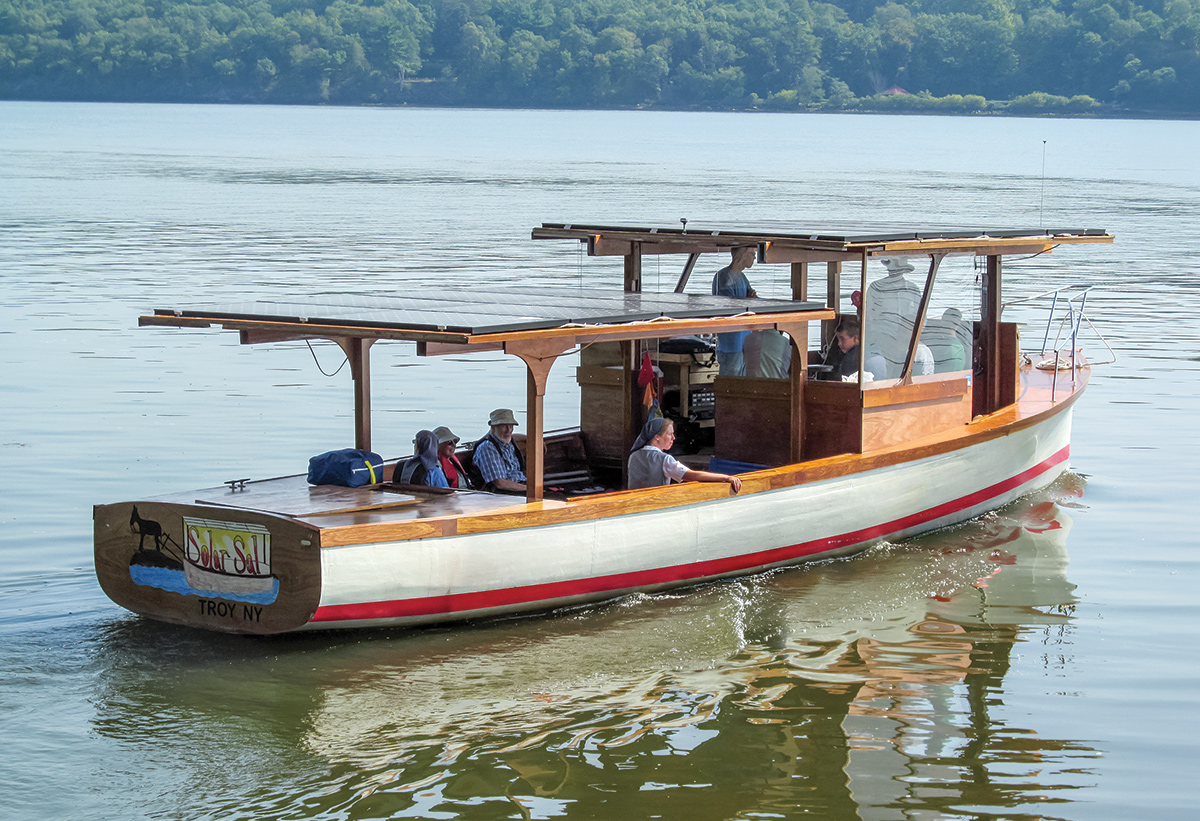
The original Solar Sal on the Hudson River. © David and Harriet Borton
In the 1800s, many American families were farmers. Think Little House on the Prairie or some other scenario that is vastly different from your current life. Farm work was all about getting the ground ready for seeds, putting seeds in the ground, and hoping to harvest enough for the winter.
If you had a mule or a horse, you could access about 10 times the power of a person. That factor of ten made it possible to plow, plant, and harvest more than your family could consume, providing a cash crop. Cash was king.
For many parts of our country, the Erie Canal brought commerce. You could sell your farm’s produce to a wider market and get a new shirt that arrived on a canal boat, many times easier than the shirt you wanted before the canal existed.
Attached to the boats by a rope, mules and horses walked along a towpath next to the canal, pulling the barges behind them as they went. Teams of horses or mules worked in shifts. Compared to overland travel of their time, these barges were the equivalent of today’s jumbo jets in terms of efficiency and scale.
Today, I use a solar electric mule to power the boats I sometimes ride on the Erie Canal. But instead of a couple of acres of grassland to feed my solar-powered mule, the area on the roof of the boat provides a couple of horsepower. This remarkable ratio, maybe 1000 to 1, results from both the inefficiency of the food chain from sunlight to animals and the over 20% efficiency of doped silicon crystals in converting solar photons into a direct electric current.
Having traveled 1400 miles, the equivalent of Maine to Florida, voyaging with my son from Bellingham, Washington, to Glacier Bay, Alaska, in a 100% solar electric boat, I feel confident to say I have a solar electric-powered mule.
Solar Sal Boats is building our 12th 100% solar powered electric boat. One of our boats, a 25-foot model, has been in operation for 14 years on an Adirondack lake with no road and no electricity. As a launch, it takes people, their baggage, and most importantly, their food to up to 50 people living in the woods in tents. Sometimes it takes lumber or a cement mixer!
The most well-known Solar Sal boat is a 44-foot commercial tour boat that generates revenue for the Hudson River Maritime Museum in Kingston, New York. Named Solaris, she is the first 100% solar U.S. Coast Guard-inspected boat.
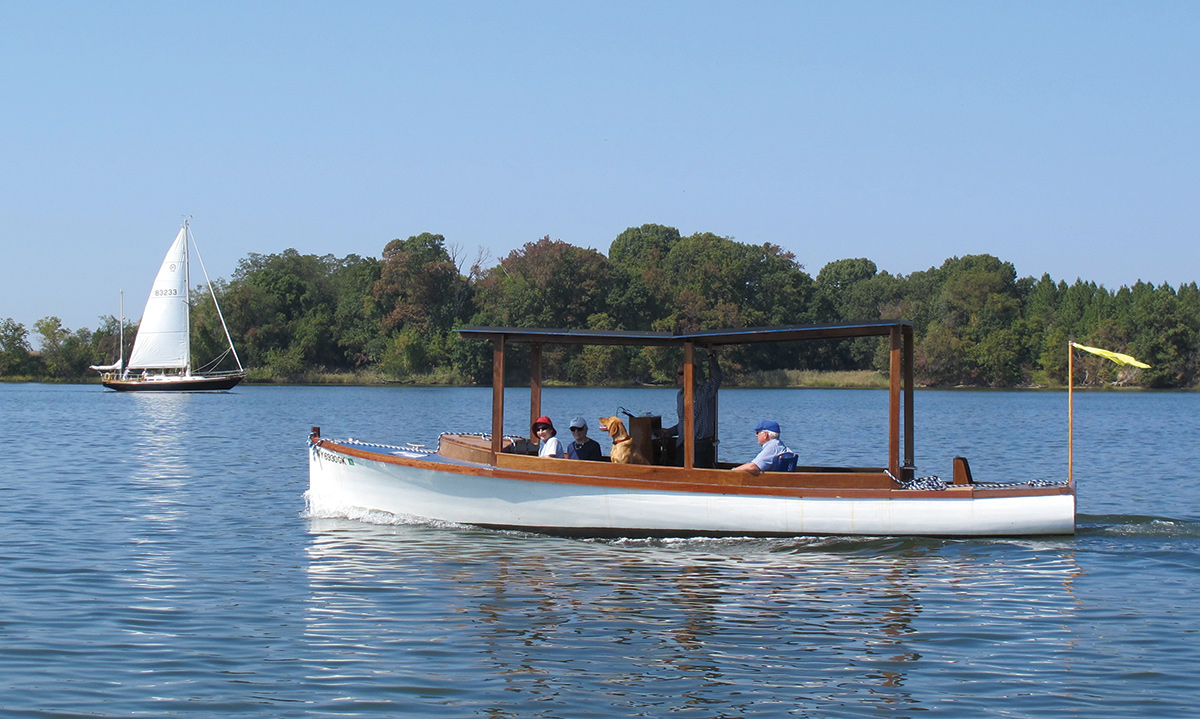
An outing on Sol, the first wooden boat. © David and Harriet Borton
Solar Boating and Alaska
During the Covid slowdown in 2020, our son Alex suggested that he and I make a solar voyage 1,400 miles to Glacier Bay, Alaska, from his home in Bellingham, Washington. This suggestion did not come out of the blue. He had been cruising around the San Juan Islands in our 27-foot solar electric boat, long enough to know the boat was good for the trip. Since I had been designing, building, and piloting solar electric boats, I knew that we could afford the fuel (free solar energy). And Covid-related slowdowns meant we could afford the time.
A Short History of Our Boats
After a couple of experiments to test the concept, in 2011 my wife Harriet and I built a 25-foot wooden solar electric boat in our garage. I named her Sol (Spanish for Sun) because I put my soul into it, and she is the sole boat I thought I’d ever make. But things turned out differently: Sol was such a good boat that I couldn’t stop! She was designed as a launch for a lake in the Adirondacks and is still in use today.
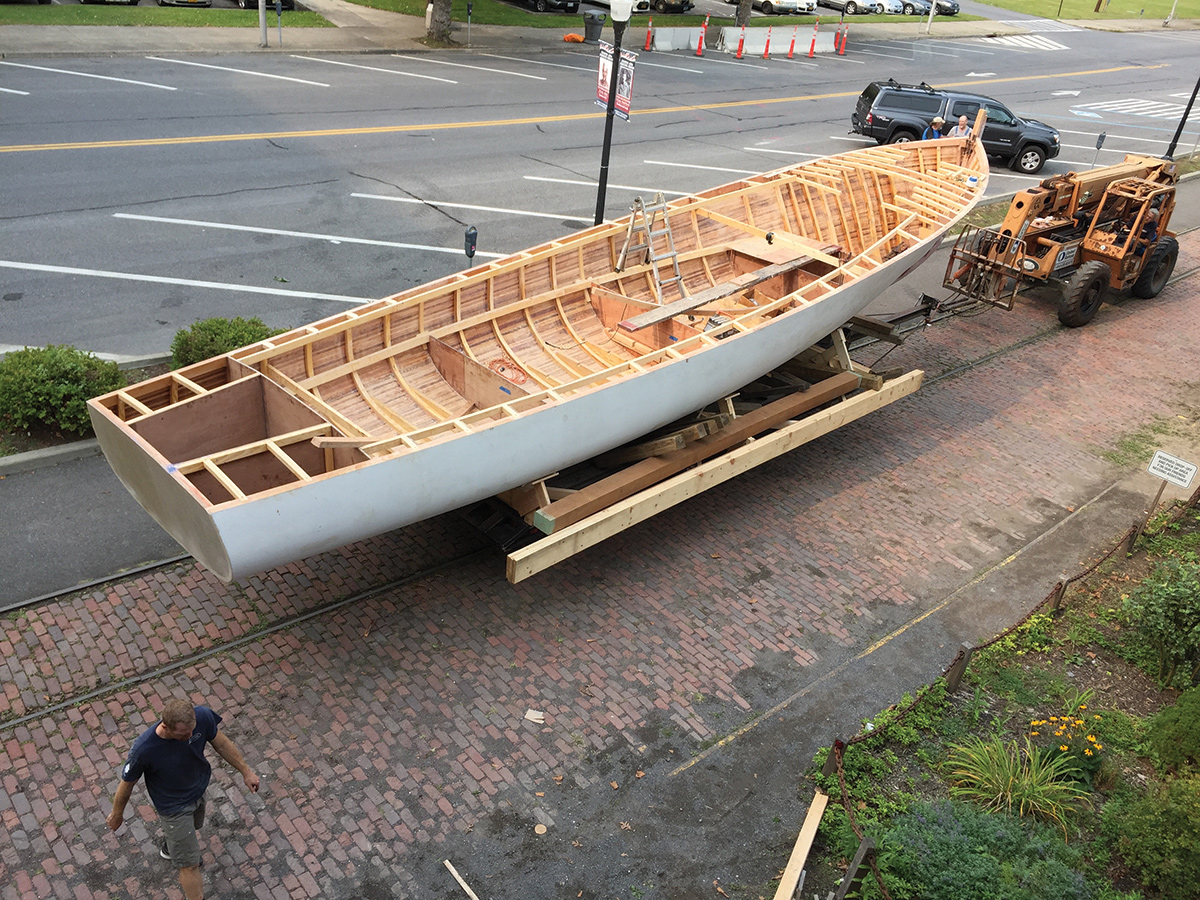
Solaris Construction at HRMM. © DHudson River Maritime Museum
The hull form of Sol was found by our son Alex. Dennis Wolfe in Michigan had made a plug in version that looked perfect for our boat. Dennis made the ribs, or forms, and bulkheads that define the cross sections of the boat for us. These shapes are mounted on a wooden frame attached to the floor of our garage. This ladderback or hardback sets up the coordinate system for shaping the boat. Once the frames are firmly attached to the hardback, I choose to use 1-inch x 1-inch red cedar strips to frame the hull.
Other traditional boat-making techniques use wider planks and other woods and make the boat right-side up. By making the boat upside down, however, the entire hull is available for attaching the strips, then smoothing the surface, and, in this case, adding a couple of layers of fiberglass for extra strength and durability. The process of getting a smooth final shape is called fairing, and the finished result is ready for painting.
Typically, the sides are painted with the desired color, and a red “boot stripe” is painted at the waterline. The bottom usually has “bottom paint,” which is formulated for saltwater or freshwater and contains ingredients to reduce the growth of plants and animals that need a surface to grow on. ‘Roll over’ is the exciting process of releasing the hull from the hardback and turning it right side up. The interior of the boat can have a wide variety of designs and features, but some items are required. Sol has an electric outboard motor hidden in a motorwell just ahead of the transom. The motor is controlled from the helm and steered by a round or spoked wheel. A throttle controls the electric power going from the batteries to the motor and thus the boat’s speed and direction.
Sol has a solid roof that supports 1.5 kW of solar photovoltaic panels. The panels’ electrical output is connected to a charge controller that provides the correct amount of power to charge the battery. This power level depends on the type of battery and the state of charge, or how full the battery is.
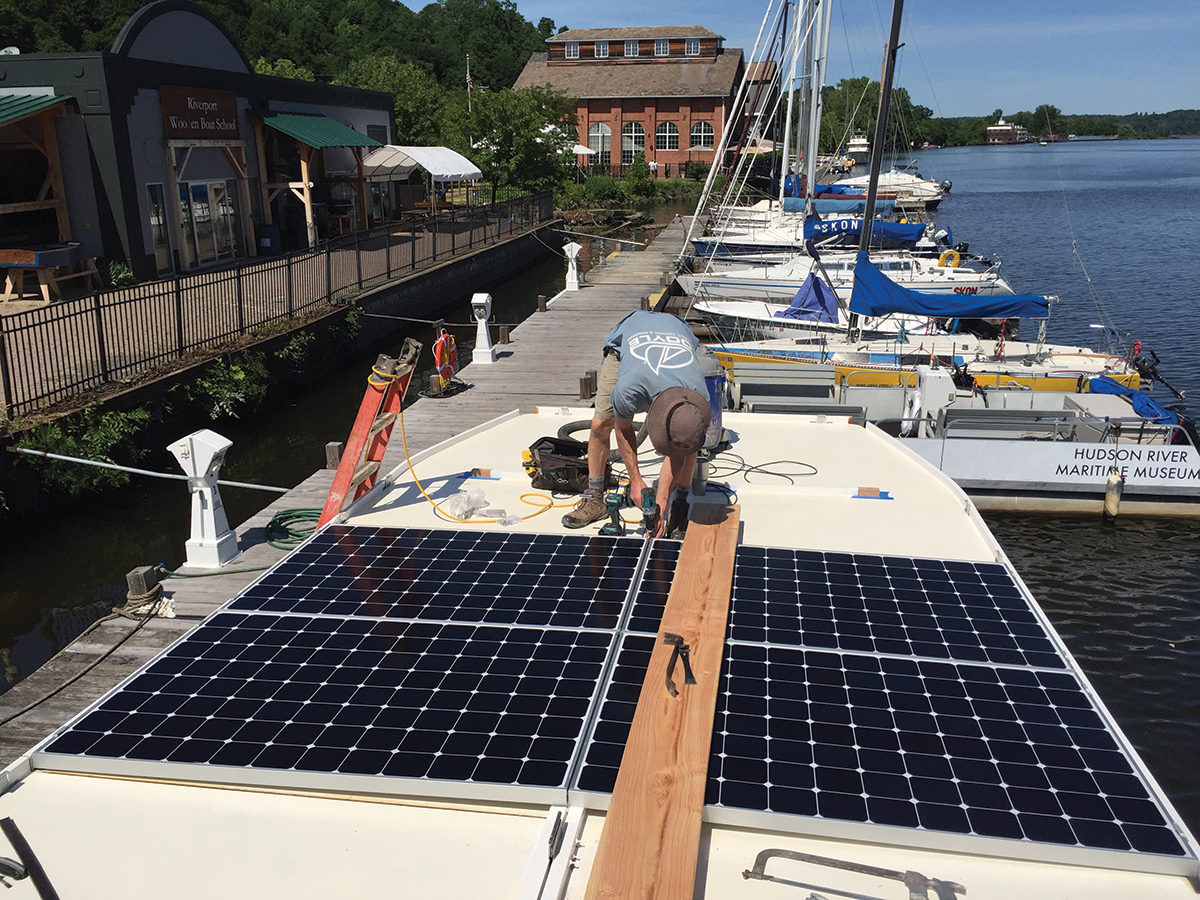
Attaching panels to Solaris roof.© David and Harriet Borton
For me, a solar-electric boat is practical if the power available on the roof approximately equals the power required to move the boat through the water at its hull speed. Hull speed is the physical limit for a displacement hull moving in the water. As the boat moves, it generates a wave, and as the boat moves faster, it generates a wave with a longer wavelength. When the wavelength equals the length of the boat, the water is pushed higher, but the boat doesn’t go faster.
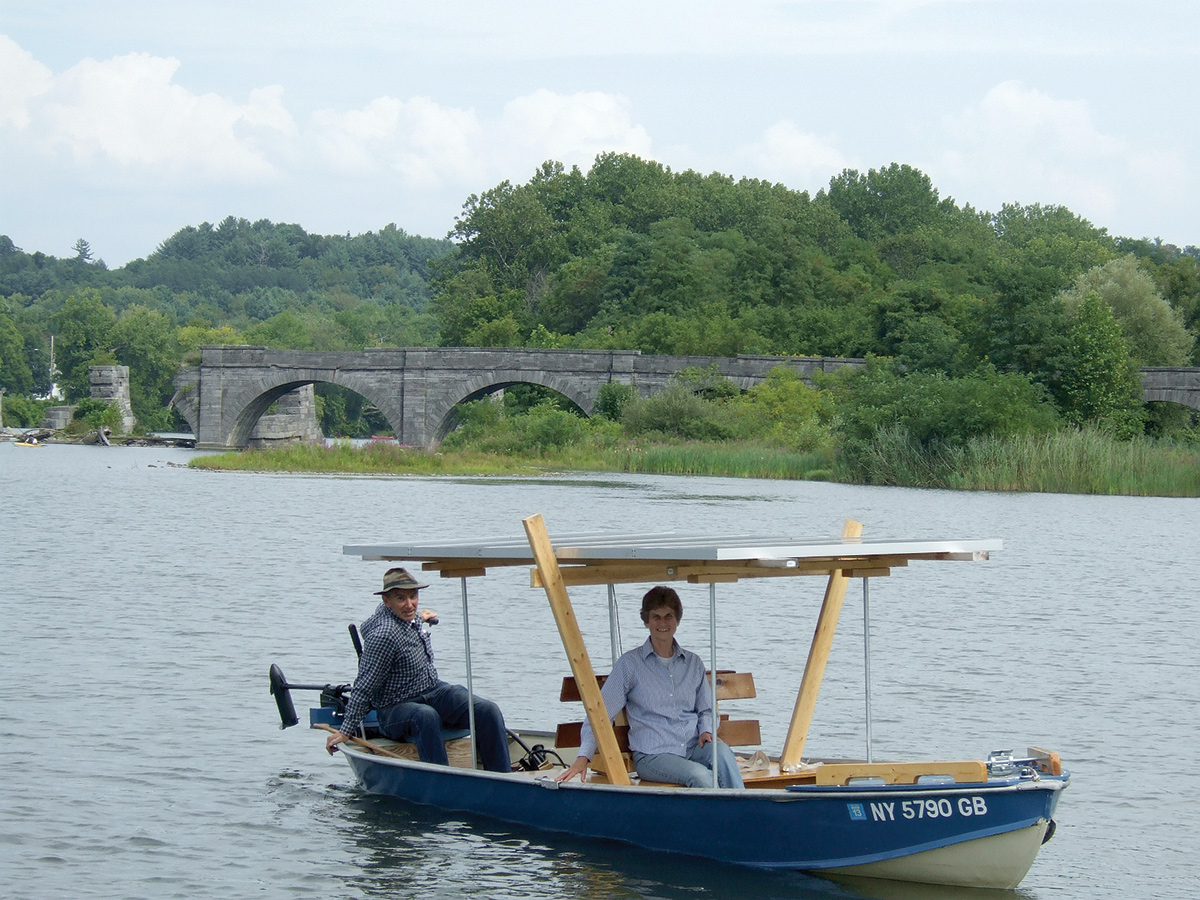
Experimental Model on Mohawk River. © David and Harriet Borton
Speed boats have a flatter bottom and more powerful, fuel-powered engines that can push the boat up and over the bow wave. This is a different physics that supports the boat in a planing configuration. Sol’s displacement hull is supported by the water around it. Planing boats are supported by pushing the water down hard enough to lift the boat up.
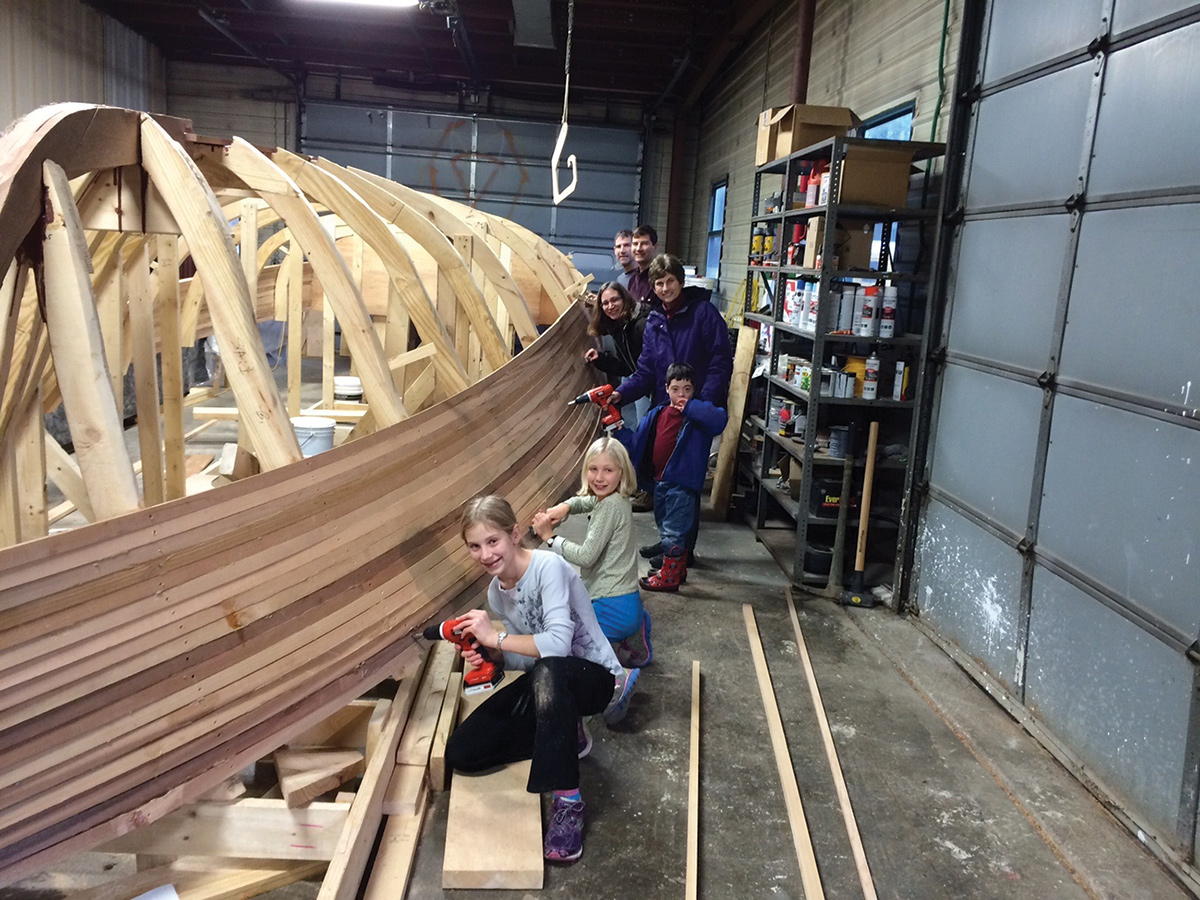
Family volunteers helping to build Solar Sal. © David and Harriet Borton
The solar panels on a solar electric boat are chosen for their high efficiency in converting light into electrical power. The system’s wiring is chosen to minimize power loss during transmission. Good charge controllers have high efficiency, and efficient batteries are a topic in and of themselves. Boat motors used to have a commutator that controlled the position of the magnetic fields by connecting carbon brushes to different windings. Recently, high-power electronic current control has enabled brushless motors and requires essentially no annual maintenance.
These practical boats have no fuel cost, require no plugging in to charge, and are usually fully charged when you step to the helm and turn on the motor. Like turning on a light switch, the power is instantaneously available.
Electric motors have several specific advantages over internal combustion engines. One is that the torque that turns the propeller is fully available when you turn up the throttle. For a fuel-powered engine, the torque depends on RPM, and so the engine must speed up to get to full torque.
A more important difference is that a fuel engine must be turning at a minimum idle speed; it can’t operate below that speed without stalling. The engine clunks into forward or reverse at idle. In contrast, an electronically controlled electric motor powers at every speed from zero to full speed, with no clunk and instant torque. This control is important for ease of docking and maneuvering in tight spaces.
Sal on the Erie Canal
My next boat was a 40-foot wooden solar-electric boat, designed as proof of concept for both cargo and passengers. She was planned for the Erie Canal, and during the building by volunteers, the group was thinking of the Erie Canal song.
“I’ve got a mule, her name is Sal, 15 miles on the Erie Canal…”
A friend suggested “Solar Sal,” and the name stuck. (We have since adopted the name “Solar Sal Boats” for our entire line of solar-electric boats.) Just after completion in 2015, the original Solar Sal made a cargo trip the length of the Erie Canal from the Hudson River to the Niagara River at Buffalo. There she picked up four tons of cardboard and returned to a paper mill a little north on the Hudson River, a 750-mile solar-powered recycling trip. This was the first carbon-free trip on the Erie Canal since mules.
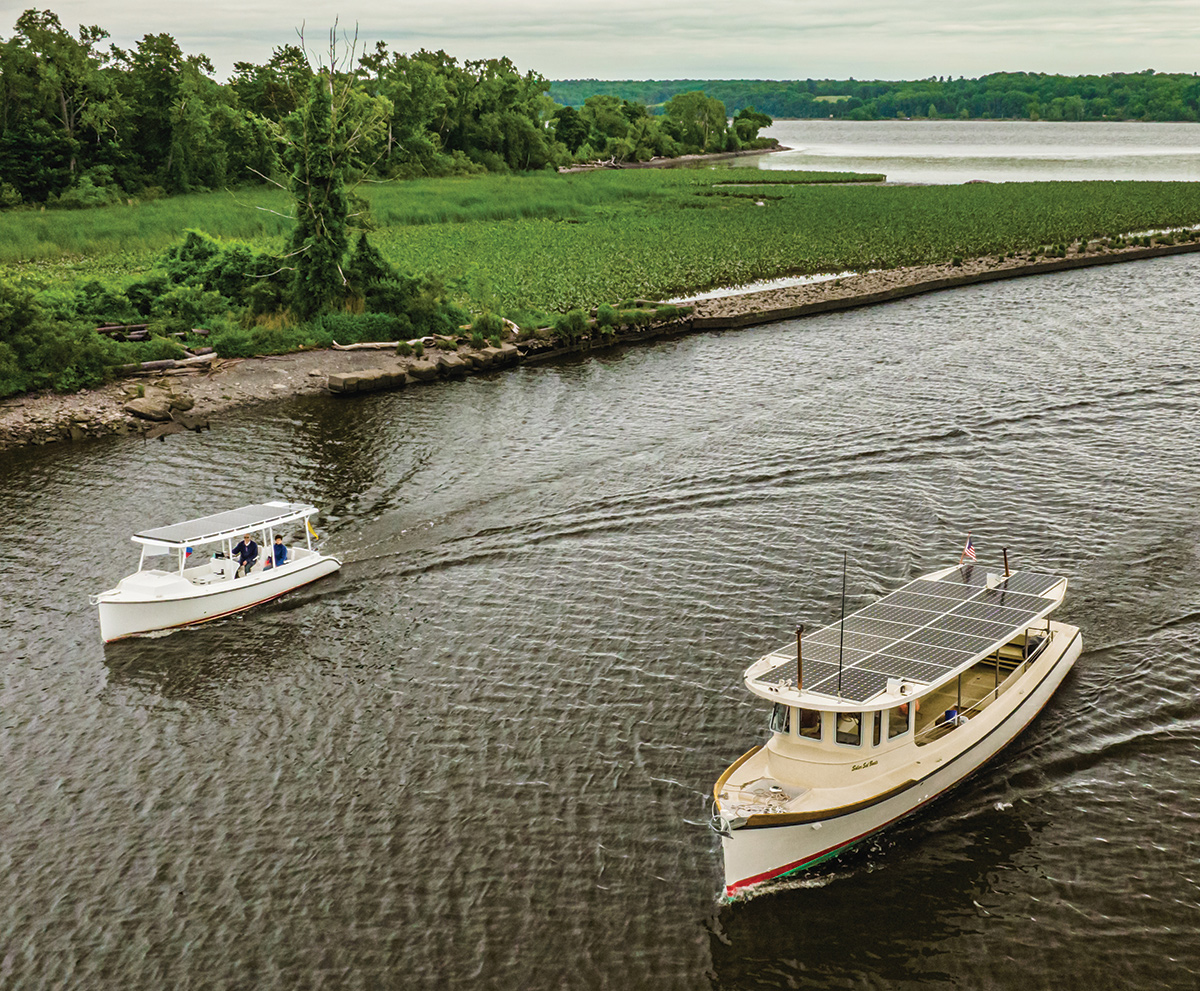
Solaris and Solar Sal 24, traveling together near Kingston, New York. © David and Harriet Borton
These boats did not generate a lot of buzz in the boating world, so we made a plan—a 44-foot, U.S. Coast Guard-inspected boat certified to carry paying passengers. That was a big change because I’m not recognized by the Coast Guard as either a boat designer or a boat builder. Therefore, we found an excellent and well-known Marine architect, Dave Gerr, and in 2017, put his detailed design out to bid. We chose the Riverport Wooden Boat School in Kingston to build her. The Boat School is part of the Hudson River Maritime Museum, and during the build, they realized she was the perfect boat for them. The museum bought her, christened her Solaris, and since her launch in 2019, they have been giving regular tours on the Hudson River and Rondout Creek. She is very popular and never needs to be plugged in.
If you think any of this was straightforward, you’d be wrong. As required for a boat carrying paying passengers, the Coast Guard was actively involved throughout the construction process. But they had incomplete rules for electric boats and no regulations for solar boats, and we had the first 100% solar-electric boat seeking Certification. That was a learning experience in both directions.
Alex, living on the West Coast, wanted to introduce solar electric boats out there. He found Sam Devlin, a well-known and respected boat builder, and together they developed a 27-foot Solar Sal for the Pacific Northwest. Our other son, Chuck, who also lives in the east, came up with the name for the west coast boat, Wayward Sun, pun intended! Alex cruised Wayward Sun around Puget Sound, the San Juan Islands, and into the Strait of Georgia in southern British Columbia.
In 2021, Alex and I prepared the boat for the Alaska trip and cruised to Sidney on Victoria Island to see if the Royal Canadian Mounted Police would let us into the waters of British Columbia during Covid. The land portion of BC was shut down to Americans, and even internal travel was curtailed. The Mounties thought our boat looked on the small side, but let us in if we followed the rules: don’t go on land; do go the shortest route; don’t stop unnecessarily, etc.
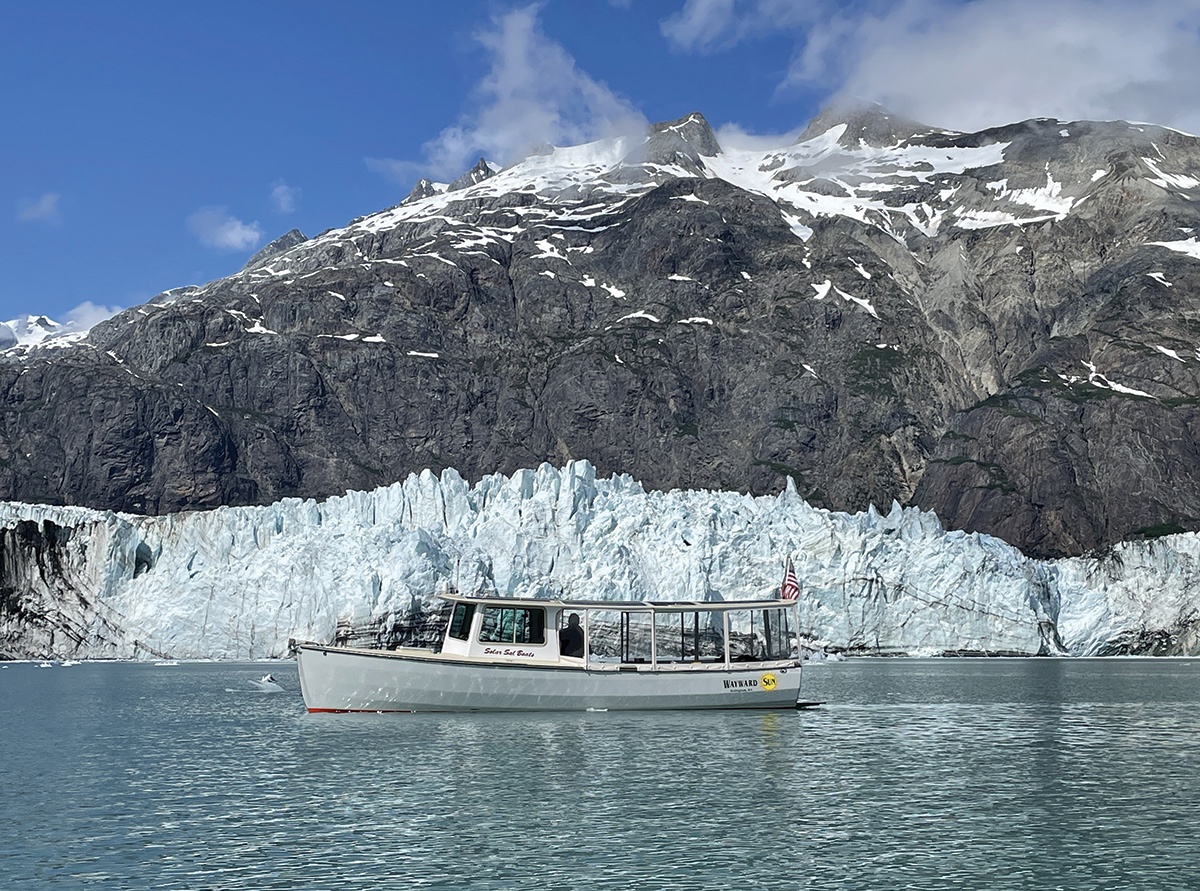
Wayward Sun in Glacier Bay. © David and Harriet Borton
About three days were sunny during the cloudy, rainy, foggy Inside Passage, but we had lots of solar energy. Because electric motors are quiet, we heard lots of whales spouting, saw lots of charismatic mega-fauna, and enjoyed mountains, glaciers, and waterfalls. Covid restrictions kept passenger vessels and cruise ships out of the waters and the docks along the way. Barges with timber and wood chips, shipping containers, and construction equipment enlivened the first half of the BC route, but thinned out the rest of the way. Occasional fishing boats went by, and a couple of times we saw them fishing.
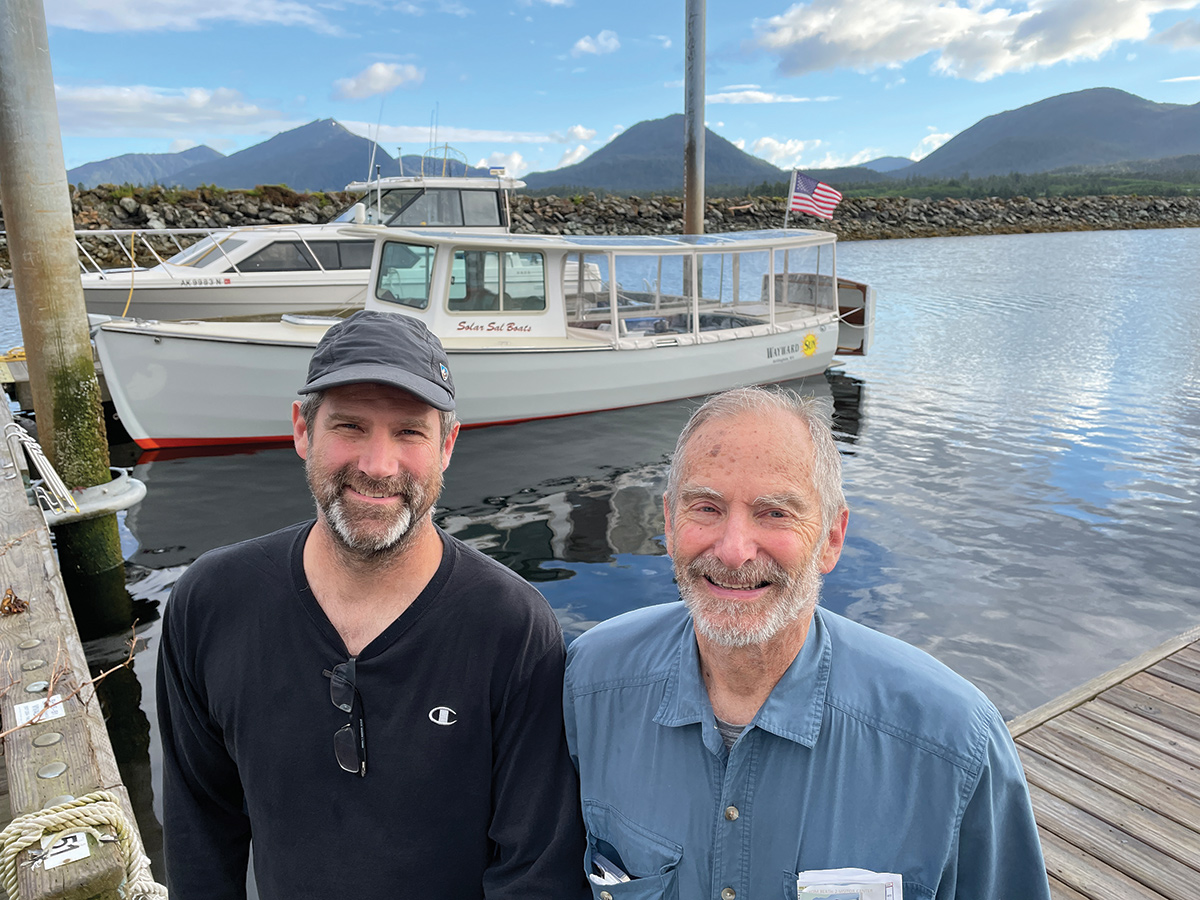
David and Alex arrive in Ketchikan, Alaska on Wayward Sun. © David and Harriet Borton
We did get a sunny day during our stop in Ketchikan and again in Juneau. The best was the sun for our day at the face of the Margerie Glacier. We could see 14,000-foot mountains and snowfields at the top of the glacier. Calving ice made lots of different noises and various iceberg pieces around us — a small boat at the foot of a 250-foot-high, half-mile-wide glacier face. It was fun to restock our food cooler with chunks of glacier ice.
To make our boats more affordable, we decided to build a smaller fiberglass model – a day boat designed for families and small groups. After making molds for a Solar Sal 24’ model, we built three 24’ fiberglass boats, all of which are currently for sale.
Our most ambitious and high-end solar boat is now nearing completion in Port Townsend, WA., with the launch expected this August. A departure from our previous boats, its semi-displacement hull allows for higher speeds, assuming plug-in charging when needed. This will give the Townsend 34 the speed and range of a comparable diesel trawler.
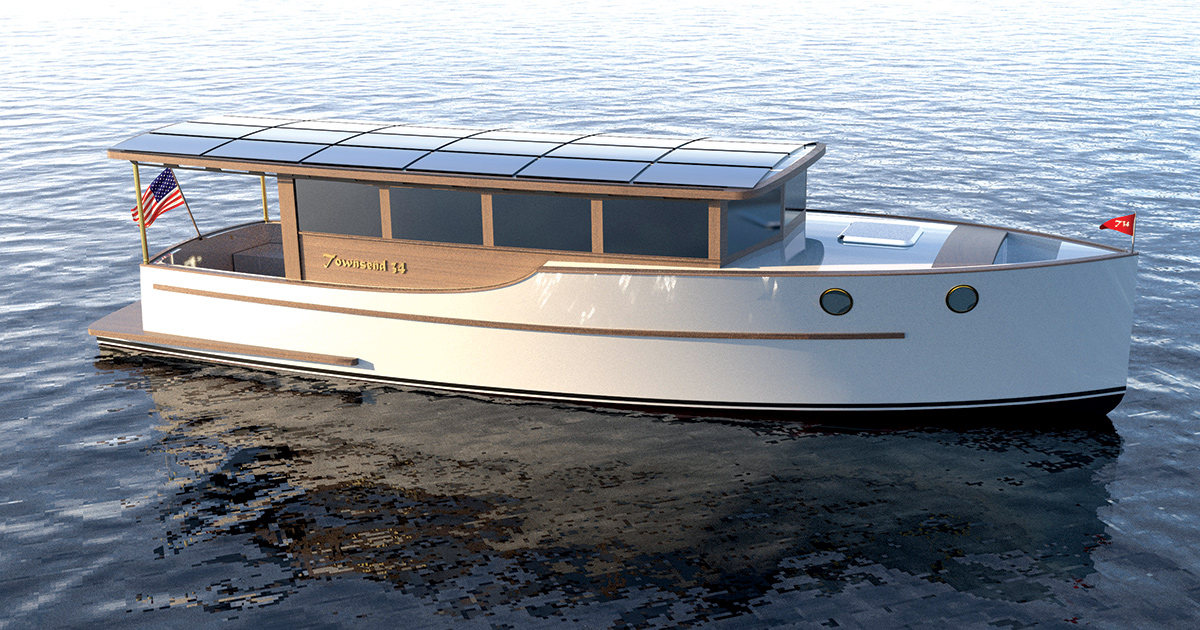
Townsend 34 artist rendering, launch expected August 2026. © Alex Borton
I know that the physics works, and I consider these solar-electric boats to be practical. Some folks may think that the speed of these boats (hull speed or sailboat speed) is too slow. But the go-fast boats require either petroleum fuel or shore-based electric power to charge their batteries. Solar electric boats silently charge themselves and take me where I want to go. And the sun’s energy is free forever.
About the Author
Capt. David Borton has been in canoes and Adirondack guideboats since birth. After the 1974 oil crisis, David put his physics Ph.D. to work in solar energy research and development and in teaching solar energy engineering. More recently, he has focused on developing solar-powered electric boats. www.solarsal.solar