




By Baker Makarem and Carla Monzer April 10, 2026
As the solar and energy storage industries continue to evolve, new technologies are reshaping how homeowners generate, store, and utilize electricity. One of the most promising yet still unfamiliar solutions is vehicle-to-home (V2H), an idea that has existed for over a decade but is only now becoming practical.
Electrical Vehicle (EV) adoption in the United States has grown rapidly. EVs reached more than 1.2 million sales in 2024, and represented about 7.5% of light-duty vehicle sales in the second quarter of 2025, according to the U.S. Energy Information Administration (EIA).1
According to a recent Edmunds article,2 used EVs are selling faster than used internal combustion engine (ICE) vehicles, at approximately 34 days to sell, compared with used ICE automobiles, which are averaging 43 days.
However, now that the U.S. government is no longer providing tax incentives, the number of new EV sales is already declining in 2026 (though there is no sign of decline in other countries).
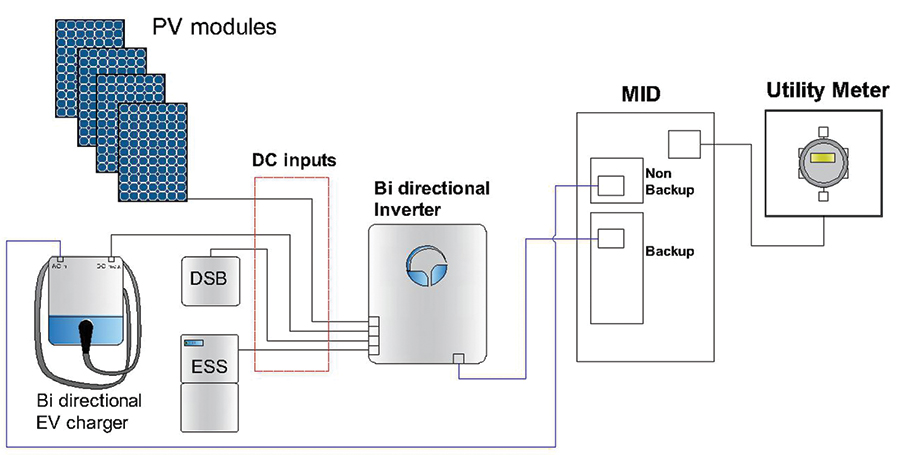
Typical V2H configuration with Solar and ESS. © Baker Makarem
As EV battery capacities increase, many homeowners are beginning to see their vehicles not only as transportation, but also as a potentially substantial backup power resource.
Before looking at how V2H works, I will briefly clarify the different types of electric vehicles:
- Battery-electric vehicles (BEVs) run entirely on electricity and are charged by the grid or a solar-powered home system.
- Hybrid electric vehicles (HEVs) combine a gasoline engine with a smaller battery that is charged internally, either by regenerative braking or the alternator.
- Plug-in hybrid electric vehicles (PHEVs) are a mix of both BEV and HEV and have larger batteries than the HEV, and can also be charged from an external source.
Almost in parallel with EV growth, more homeowners are installing rooftop photovoltaic (PV) systems. One study found that roughly one in four EV owners also own solar,3 which is a natural pairing, since both technologies allow households to reduce emissions, cost, and gain greater energy independence.
How Does Vehicle-to-Home Actually Work?
Vehicle-to-home relies on bidirectional charging, as opposed to a typical EV charging setup, in which electricity flows only one way, from the home or grid into the vehicle.
A bidirectional charger, however, allows electricity to move in either direction. When needed, or also when electricity rates are high, the EV battery can discharge energy back into the home or back to the grid to be sold.
Several major automakers now support or plan to support bidirectional capability in the U.S. market. These include GM, with several EV models such as Silverado, Equinox, Bolt, Hummer, and Cadillac; Ford with the F150 Lightning, Tesla with the Cybertruck, Hyundai with their IONIQ family, and many others. There will also soon be ways to retrofit existing EVs for this purpose.
The functionality depends not only on the vehicle, but also on the charger, inverter, and home electrical configuration. In all cases, the home must include means to safely isolate the house from the utility grid during backup operation, so as not to harm linemen during an outage. Here’s how it works: in normal grid operation, the EV is charged via the grid. In an outage, the microgrid interconnection device (MID) switches to backup mode, powering only what is in the backup section (the homeowner can choose how much of the house needs to be backed up). The dark start battery (DSB) powers the components to keep communication, while waiting for the EV to plug in and the customer to initiate the backup mode.
Put simply, the EV battery serves as a temporary home power source, similar to a stationary home battery. Because EV batteries are often much larger than typical residential storage systems, one fully charged vehicle can supply a home for many hours, sometimes even multiple days, depending on usage and the support of additional sources such as a rooftop solar system.
There is also another advantage: using the battery to sell electricity back to the grid. Homeowners who live in a region where the utility charges time-of-use (TOU) prices, the homeowner can fill up at night when there is less demand for electricity, or in some places, such as California, where there is an abundance of solar keeping prices down, and then send (and sell) power back to the grid when demand is high and more expensive.
Why V2H Matters for Resilience
Power outages are becoming more frequent in many parts of the country due to severe storms, grid congestion, and wildfire-related shutoffs. Nationally, the average outage lasts about 11 hours,4 although the duration can be much higher in certain states and during extreme weather events.
There are states such as South Carolina where the average duration of interruption is greater than 50 hours, and the number of interruptions is close to two and a half days.
Traditionally, homeowners seeking backup power have relied on diesel or gasoline generators. More recently, stationary lithium-ion storage systems alone or paired with rooftop solar have become popular. V2H adds a new option: using the battery you already drive.
For homeowners who already own an EV, V2H could:
- reduce or eliminate the need for generators
- provide quiet, clean backup power
- complement rooftop solar
- improve household energy independence
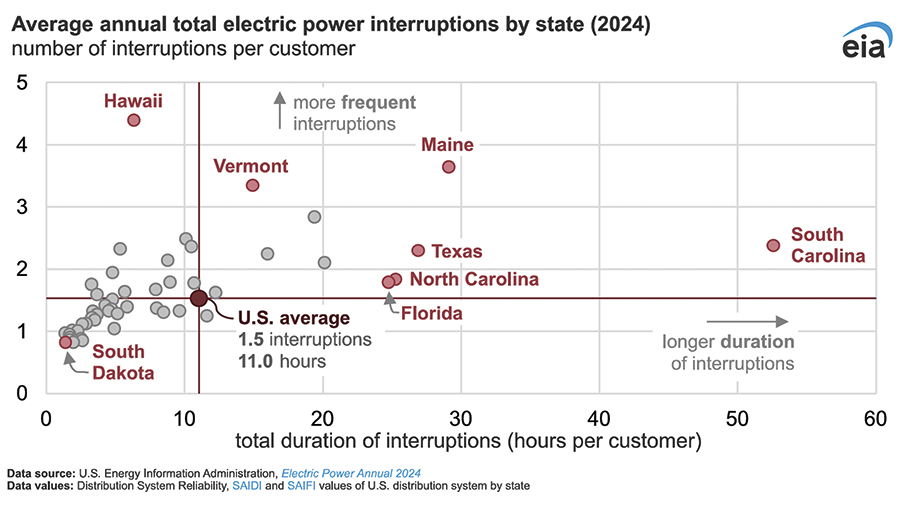
U.S. Energy Information Administration, Average annual total electric power interruptions by state (2024). retrieved from EIA,In Brief Analysis: Hurricanes in 2024 led to the most hours without power in the United States in 10 years; https://www.eia.gov/todayinenergy/detail.php?id=66744, January 5, 2026. © eia
And because EV batteries range widely in size, from about 60 kWh in many BEVs to even higher capacities in some models, they can store significantly more energy than the average stationary home battery. Also, of course, it does not have to be fixed to one place. If the battery runs low, the homeowner has the option to drive to a nearby functioning supercharger, leaving the house without power for only a short time.
Additionally, and from an emissions standpoint, battery-electric vehicles produce roughly 70–80% fewer lifetime CO₂ emissions than conventional gasoline vehicles, depending on the regional electricity mix. Plug-in hybrids typically provide moderate reductions as well. HEV is approximately 45% less, and a PHEV is 63% less.5
![U.S. Bureau of Labor Statistics, Average Price: Electricity per Kilowatt-Hour in U.S. City Average [APU000072610], retrieved from FRED, Federal Reserve Bank of St. Louis; https://fred.stlouisfed.org/series/APU000072610, January 5, 2026.](https://ases.org/wp-content/uploads/2026/04/v2h-04.jpg)
U.S. Bureau of Labor Statistics, Average Price: Electricity per Kilowatt-Hour in U.S. City Average [APU000072610], retrieved from FRED, Federal Reserve Bank of St. Louis; https://fred.stlouisfed.org/series/APU000072610, January 5, 2026. © FRED
Facts and Studies: What Research Says About Costs
Readers often ask: How much does owning an electric vehicle really cost, and how does V2H change the equation? When compared with fueling and maintaining a conventional gasoline vehicle, the difference is substantial. So, while EV drivers do buy more electricity, their total fuel, maintenance, and time spent is significantly lower.
A simple real-world comparison illustrates this further. One road test reported that an electric pickup truck traveled 400 miles using 204 kWh of stored energy.6 Using the U.S. average residential electricity rate of $0.188 per kWh,7 that full charge would cost: 204 kWh × $0.188/kWh = $38.35.
It is important to note that the average price of electricity has increased from 2020 to 2025 by approximately 40%, and is expected to continue to rise.
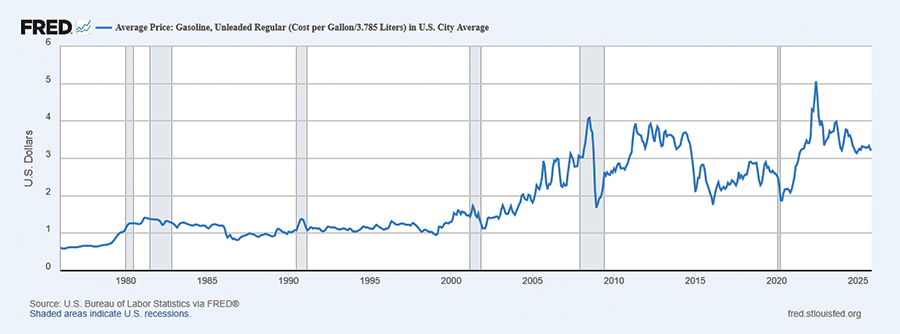
The gasoline version of the same truck has a 24-gallon tank. At an average retail gasoline price of $3.2288 per gallon, filling the tank would cost $77.47.
There are additional cost savings associated with electric cars. EVs do not need oil changes, and due to regenerative braking, where the motor slows the car, rather than brake pads only, EVs need many fewer brake replacements. Additionally, EV motors have between 20 and 50 moving parts, versus over 1,000 for ICE cars. With a lot fewer parts, there are a lot fewer, and costly, things to go wrong.
Here it can be seen that the average price of gas has increased from 2020 to 2025 by approximately 75%.
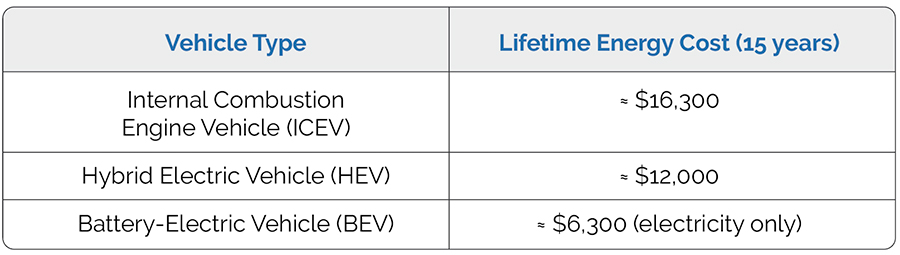
A recent peer-reviewed study examining EV ownership over a 15-year vehicle lifetime shows that Vehicle-to-home charging can cut costs and greenhouse gas emissions across the USA. The study found that adding a battery-electric vehicle (BEV) increases the typical household electricity bill by about $6,300 over that period,9 but that is still significantly less than the cost of fuel for a regular gas vehicle.
When vehicle-to-home capability is added, the financial benefits expand. Research modeling V2H use across U.S. households suggests that using an EV battery to offset home electricity consumption, particularly during peak-rate periods or grid outages, can yield additional savings averaging about $3,800 over 15 years.10 These values do not take into consideration the potential savings from an outage (remember the last time you had an outage and had to throw away everything in the fridge and the freezer?)
In short:
- EVs cost less to fuel than gasoline vehicles
- EV charging increases household electricity use, but at a net savings
- V2H adds an additional layer of value by reducing grid electricity purchases
- Time of Use (TOU) also allows the consumer to “fill up” when rates are low and sell back when rates are high
And when paired with rooftop solar, V2H allows households to store excess daytime generation for later use, improving self-consumption and resilience.
Opportunities and Areas for Improvement
Think back to the size of PV modules years ago and how they have lately improved in wattage and footprint. What about how heavy lithium-ion energy storage systems used to be? Believe me when I say they were very heavy, and I hope my chiropractor doesn’t read this!
Vehicle-to-home capability is a promising technology, and several major automakers have now embraced it. This is good news for both consumers and the renewable energy industry.
When V2H is paired with rooftop solar, and optionally with stationary battery storage, homeowners gain more control over both their energy costs and their resilience during outages.
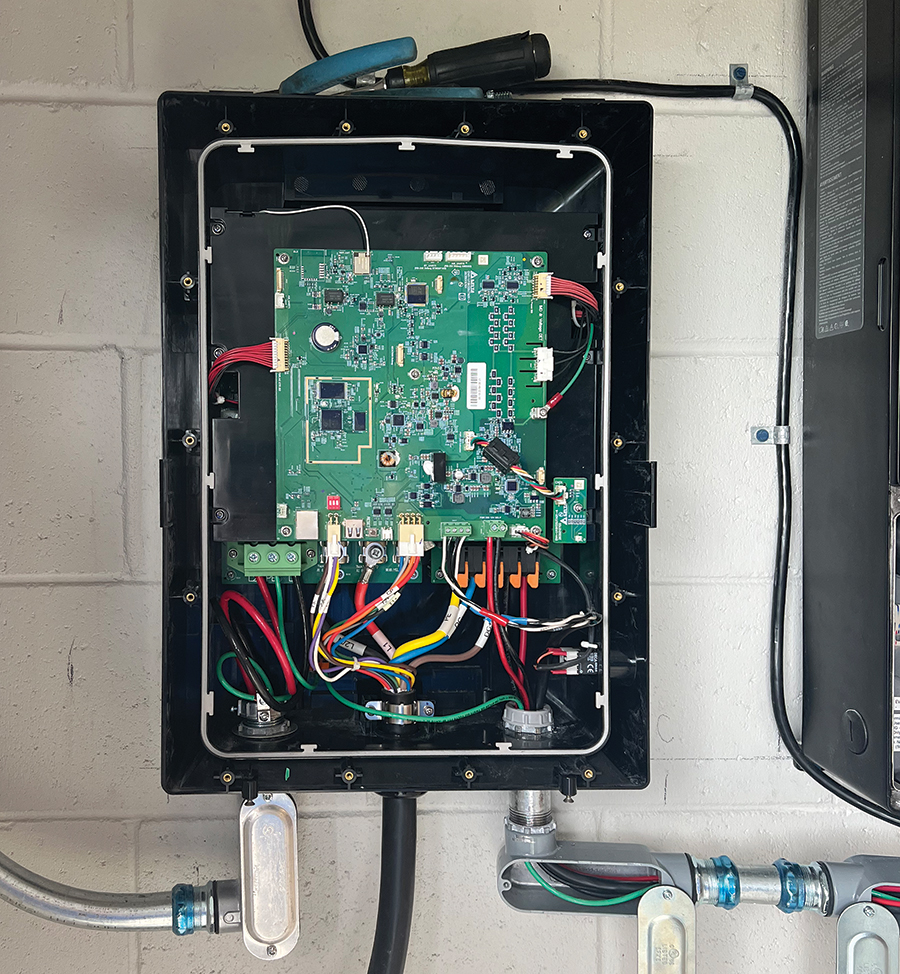
Bi-directional charging setup. © Baker Makarem
Additionally, as the technology becomes more common, there are several important opportunities for even more improvement.
Broader Access Across Vehicle Models
Today, V2H capability is more often limited to higher-priced, premium-trim EVs. Expanding this functionality across all EV segments, including mid-market models, would help ensure that energy resilience is not restricted only to higher-income buyers. Affordability remains a key factor in EV adoption, and widespread V2H deployment will depend on inclusive pricing strategies.
Enabling Flexible Self-Consumption
Another opportunity lies in enabling EV batteries to support household electricity needs during normal operation, not only during outages. For example, a home with rooftop solar could charge an EV during the day and then use that stored energy in the evening, when rates are higher, and the vehicle is available.
In a household with two EVs, where each car is only in use part of the time, a smart energy-management system could draw stored solar energy from whichever vehicle is available. This would:
- improve renewable-energy utilization
- reduce reliance on the grid during peak periods
- potentially lower the size and cost of stationary energy storage systems (ESS)
Open Standards and Interoperability
Today, some V2H systems are closely tied to proprietary home-energy ecosystems. For homeowners with a solar installation, retrofitting a brand-specific V2H product can add cost and complexity.
Allowing EVs and chargers from different manufacturers to communicate and interact at the bidirectional level would:
- allow V2H systems to integrate with existing PV installations
- reduce hardware compatibility barriers
- give consumers greater freedom of choice
- lower system costs over time
This approach treats the EV more like a universal “battery on wheels,” rather than a product locked inside a single ecosystem.
Real-World Example
Imagine a household with two EVs. A severe storm is forecast, and nearby family members, who already have rooftop solar, lack backup storage. With interoperable V2H systems, the homeowner could temporarily connect one vehicle to power the home during an extended outage and lend the second vehicle to the other home.
This type of clean, mobile backup could avoid the need for a fossil fuel generator or the cost of installing a stationary ESS with smaller capacity — potentially saving $10,000 or more in hardware and installation.
Giving consumers that flexibility allows the technology, as well as the market supporting it, to grow naturally.
Economic Factors Shaping the Future of V2H and EV Adoption
Economic policy plays a central role in how quickly new energy technologies are adopted. Recent federal tax credits for EV purchases in the U.S. helped accelerate market growth, but their expiration in 2025 may signal a new phase, one focused on affordability and cost reduction rather than incentive-driven demand.
In theory, tax credits can stimulate technology adoption, and with that, research into technology improvements. However, credits may also allow manufacturers to maintain higher pricing, as part of the purchase cost is absorbed by public support.
When incentives decline, market competition often shifts toward lowering production costs and expanding access. This dynamic may help explain why several major automakers are now refocusing on lower-cost EVs, hybrids, and plug-in hybrid models.
These U.S. EV manufacturers that provide V2H (Ford, Tesla, Kia, GM) did not start with lower-cost EVs from the beginning, as other countries did.
Another factor influencing EV pricing is the tariff structure applied to imported components and materials. As economist Thomas Sowell notes in Basic Economics, tariffs tend to raise the final cost of consumer goods by shielding domestic producers from lower-priced competition.
Ultimately, these costs are borne by end users, including EV buyers. As the industry matures, tariffs and trade policy will continue to affect affordability and, thereby, adoption speed.
If you cannot compete, then allow other manufacturers to provide their products and learn from them.
What the Next Phase May Look Like
In the near term, smaller, lower-cost EVs equipped with V2H capability may represent an important bridge technology. This model is particularly well-suited to urban areas where daily driving distances are modest, charging access is common, and electricity costs are above the national average, particularly in places that have Time of Use prices.
In these settings, pairing a compact EV with rooftop PV and maybe also a modest stationary ESS can deliver meaningful economic and resilience benefits.
Plug-in hybrid electric vehicles (PHEVs) may also play a role. With battery capacities now ranging from roughly 10 kWh to as high as 70 kWh in some new global models, PHEVs can offer both electric-driving capability and long-range flexibility.
If V2H functionality becomes standard across PHEV offerings, households in regions with limited charging infrastructure could still benefit from bidirectional energy use.
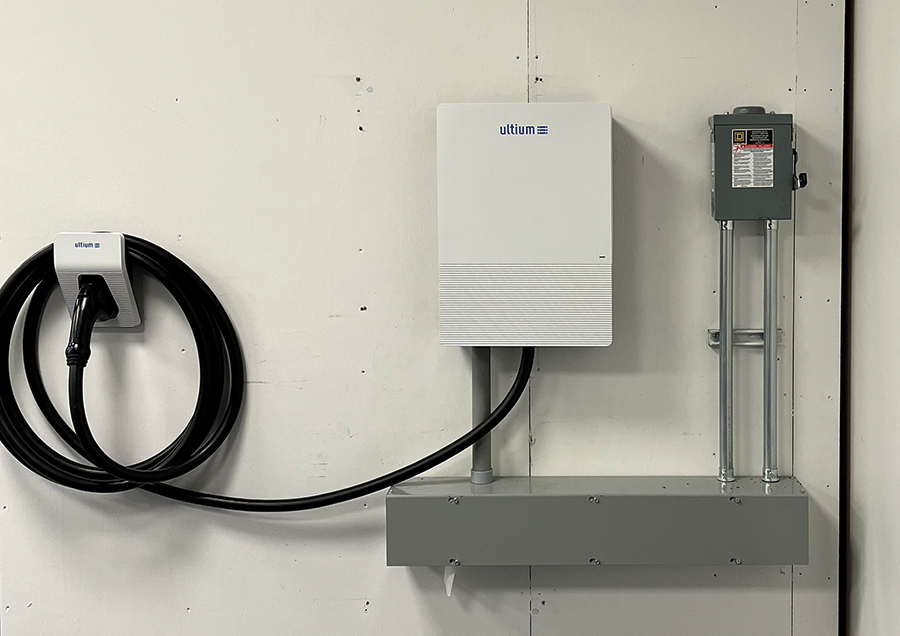
Bi-directional charging setup. © Baker Makarem
Incentives Beyond Federal Policy
Even as federal EV purchase credits phase out, state and utility-level incentives remain active across much of the country.
For example:
- Arizona Public Service offers programs such as EV Charging Assistant Rewards, which adjust charging schedules to align with renewable generation and grid needs, providing both sign-up and monthly participation credits.
- The Illinois Environmental Protection Agency continues to provide rebates for qualified buyers of new or used all-electric vehicles.
- Many utilities nationwide now offer off-peak charging rebates or TOU rate incentives, further lowering operating costs for EV owners.
These programs encourage smart-charging practices that align well with V2H, where vehicles are viewed not only as transportation assets but as flexible energy resources. This also allows utilities to study energy consumption for better forecasting of their power generation.
Looking Forward
As the EV and solar industries evolve, several questions will shape the next decade:
- Will V2H become a standard feature across vehicle classes?
- How quickly will open interoperability standards expand consumer choice?
- Will the combination of EVs, rooftop solar, and smart charging reshape how households think about energy independence?
What seems increasingly clear is that vehicle-to-home capability strengthens the connection between transportation and clean energy, turning the EV into a cornerstone of resilient, distributed power.
About the Authors
Baker Makarem is a Mechanical Engineer and NABCEP-certified ESIP, PVIP, and PVSI. He is the founder of Bakertech, a company specialized in the photovoltaic (PV) and energy storage systems (ESS) industry. He has been in the renewable energy field since 2017.
Carla Monzer previously worked as a marketing consultant in a global market research firm providing consumer, industry, and market intelligence. She is currently a PhD student in Marketing at the University of South Florida. Her research interests focus on sustainability, with particular attention to renewable energy and its interaction with
consumer behavior.
Sources: