




By Christian Custode January 21, 2026
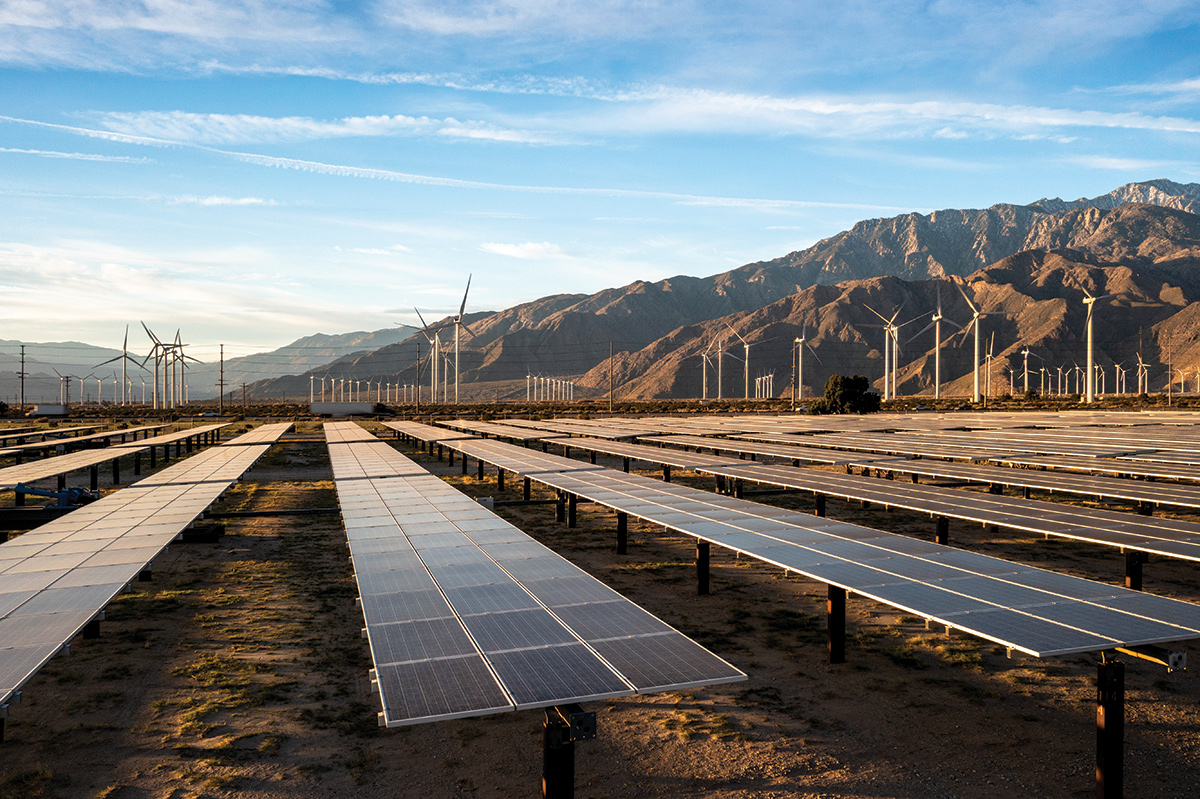
Solar panels and wind turbines in Palm Springs, California. © Adam Kaz
For decades, the conversation about renewable energy has centered on technology: panels, batteries, and grids. But the real challenge today isn’t how to capture sunlight; it’s how to finance inclusion. Across the United States, millions of families and small communities still can’t access solar power, even as costs fall and incentives expand.
The solution lies not in inventing new equipment but in reimagining how capital flows. From my experience in energy finance, I’ve seen that access to clean energy follows the same logic as access to credit: it rewards those who already have assets and excludes those who don’t.
A more balanced approach – what could be called blended finance creates shared ownership by aligning government support, private investment, and community participation. It’s not just a funding mechanism; it’s a philosophy of collaboration.
The Limits of Traditional Solar Finance
Traditional project financing favors scale, predictability, and low risk. Those parameters are ideal for utilities and corporations but leave behind rural cooperatives, low-income neighborhoods, and tribal nations.
The barriers are structural: limited collateral, lower consumption levels, and fragmented demand. Yet these same communities stand to gain the most from solar energy with lower bills, local job creation, and energy resilience.
Blended Finance: A Framework for Shared Benefit
Blended finance works by combining three sources of capital that, together, create stability and trust in a project:
- Public capital provides seed funding, often in the form of grants or guarantees, reducing risk for others.
- Private investment supplies most of the funds, motivated by steady returns and clear cash flows.
- Community participation through cooperatives, bonds, or local subscriptions ensures affordability and ownership.
When these forces align, the outcome is a self-reinforcing model: government funds attract private capital, which in turn multiplies community participation. It’s a virtuous cycle that transforms solar projects from external interventions into locally sustained enterprises.
From Concept to Impact
Imagine a solar project serving hundreds of households. Instead of asking who will pay first, the model asks: how can each actor benefit proportionally? The government sets the foundation, private investors bring efficiency and discipline, and communities provide purpose and stability. Together, they form an ecosystem of shared power. The results can be transformative.
Households gain predictable energy costs. Investors secure long-term revenue streams with low volatility. Local organizations from schools to cooperatives gain recurring income through participation fees or ownership shares.
Every dollar invested in generates electricity and increases social and economic value.According to the National Renewable Energy Laboratory (NREL), distributed solar can generate up to 15 local jobs per million dollars invested. Add community participation and those jobs turn into careers sustained by pride, not subsidy.
Lessons from the Field
In several pilot experiences I’ve observed, community-driven financing has changed the tone of renewable projects entirely.
Instead of external developers promising benefits, residents become co-owners of progress. When communities invest modestly, they protect the project, attract talent, and spark a sense of belonging.
The Department of Energy’s Community Power Accelerator shows that partnerships between public agencies and local cooperatives can reduce costs by 15–25% compared to purely private development. Financial innovation, not just engineering, is what unlocks that potential.
Data-Driven Design and Replication
Equitable solar finance needs data and transparency. Projects should start with a financial model that measures social impact and ROI. Tools like Power BI dashboards and open-source models help stakeholders preview project outcomes before installation.
A practical example is creating a revolving fund that automatically reinvests part of community savings into future installations. This mechanism ensures scalability without dependence on continuous government subsidies.
A Call for Collaborative Policy
To scale inclusive solar financing, policymakers must think beyond tax credits. The key is to blend grants with soft loans, standardize community participation models, and simplify permitting for shared ownership.
Programs like the Rural Energy for America Program and state-level clean energy banks are already testing these ideas but coordination remains essential. Financial innovation should be treated as a clean-energy technology subject to research, testing, and replication. By fostering open dialogue between financiers, engineers, and communities, we can ensure that no one is left behind in the solar transition.
The Power We Share
The energy transition will not be won solely by megawatts or tax credits; it will be won by inclusion. Shared power means more than electricity generation; it means shared responsibility and shared prosperity. Blended finance is not charity, it’s strategy. It creates projects that make financial sense while building social capital. The future of solar finance lies in collaboration.
By aligning incentives, empowering communities, and trusting in the multiplier effect of shared ownership, we can turn sunlight into opportunity for all.
About the Author
Christian Custode is a financial strategist and ASES member specializing in renewable energy investment models. He serves as Financial Planning & Portfolio Economist at Ecopetrol USA, Inc and leads Business Planning Consulting LLC, focused on sustainable finance for community solar and tribal energy projects.