



By Baker Makarem and Carla Monzer April 10, 2026
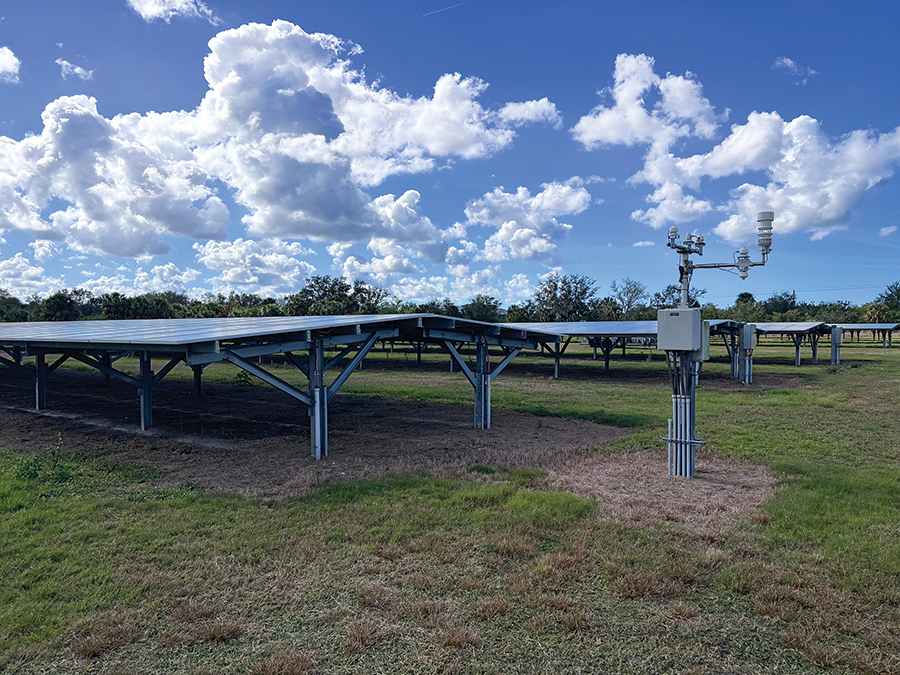
While not optimally positioned, the East-West orientation can allow for the installation of more panels in the same area. © Baker Makarem
If you ask ten solar professionals how to orient a rooftop array in the Northern Hemisphere, most will answer the same way: face it south. And for many projects, that remains a solid default. A south-facing array typically squeezes the most energy out of each panel.
But on many commercial roofs, and especially on flat rooftops, the real constraint is not the sun. It is space.
When roof area is limited, the question becomes: What layout lets you install the most space-efficient solar capacity within budget on the available area? In those scenarios, an east–west (E–W) layout can outperform a south-facing layout. The South layout may be “better positioned”, but the E-W allows the installation of more panels in the same area.
This article walks through when an E-W configuration makes sense, using a straightforward roof example and five case studies across the U.S.
A Quick Clarification: What We are Comparing
Before the numbers, it helps to define what “better positioned” means:
- South-facing fixed tilt at optimal inclination often maximizes energy per panel.
- E-W at low fixed tilt often maximizes power per available area.
The Two Conditions where East–West Shines
East–West is not a replacement for south-facing arrays in every situation. The advantage tends to show up when both conditions apply:
- You are working on a flat surface. This includes flat roofs (such as malls, warehouses, office buildings, apartments, and houses), flat canopies with space constraints, and potentially floating PV platforms, such as those on ponds or reservoirs.
- The tilt angle is low: from 5° to 10.° Low-tilt arrays are commonly used on flat roofs because they can reduce wind uplift forces and minimize row-to-row shading.
Low tilt is common on flat roofs for practical reasons:
- It reduces the uplift load and helps manage wind-related structural requirements.
- It can reduce row-to-row shading constraints because the array sits lower.
- It can simplify roof loading strategies when using ballast systems.
When those two conditions are present, east-west layouts often allow tighter packing, meaning a higher power density. Also, on a space-limited roof, higher power density can translate into stronger project economics.
A Simple Roof Example (4,290 sqf)
To illustrate this trade-off, consider a flat surface measuring 4,290 square feet (sq ft) with the goal of installing as much solar capacity as is practical.
Option A is a conventional design approach that would use a south-facing ballast-mounted system. Using 450-watt modules at a 10° tilt, this surface can accommodate 120 panels, resulting in a 54 kW DC system.
Option B is an E-W configuration using the same 450-watt modules. With an 8° tilt (the same angle used by the same manufacturer for the South example), the same surface can fit 152 panels, for a total of 68.4 kW DC.
What Changed?
The roof did not get bigger. The type of module did not change. What changed is the layout efficiency.
In this example, the east–west configuration increases installed capacity from 54.0 kW to 68.4 kW, a 27% increase in capacity on the same footprint. That is the core advantage: more watts installed per square foot, which will generate more energy.
What Does that Mean for Energy Production?
To understand how this plays out, five case studies were evaluated using NREL’s PVWatts tool, assuming a 0.5% annual module degradation rate. The locations were chosen to represent a range of U.S. climates:
- Orlando, Florida
- Bakersfield, California
- Malta, New York
- Seattle, Washington
- Lincoln, Nebraska
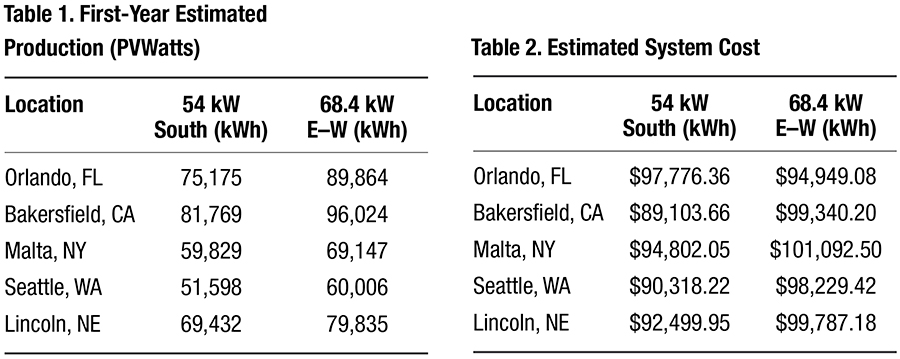
As expected, the east–west systems produce more energy in every location, not because they are more efficient per panel, but because they are larger systems on the same roof. Of course, if you can install the same amount of PV modules facing south, you will get higher energy generation than the E-W, but can you install more?
The more important question, however, is whether that additional production justifies the cost.
Installed Cost: More Capacity Does Not Always Mean Higher Cost
Estimated installed costs were calculated for each system, accounting for typical regional labor rates and site-specific structural requirements.
Structural costs vary by location. High-wind regions, such as Orlando (design wind speeds up to 137 mph), and heavy-snow areas, such as Malta, New York which can reach up to 76 pounds per square feet (psf), increase racking and ballast requirements. These factors affect both layouts, though E-W systems can sometimes distribute loads more efficiently.
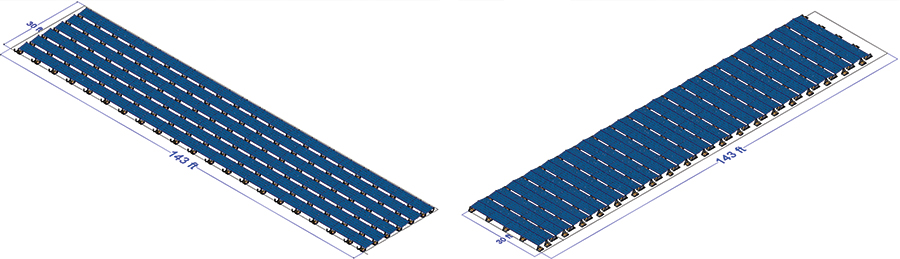
Option A (left): South-facing ballast system, tilt angle 10,° 120x450W PV modules. Option B (right): E-W facing ballast system, tilt angle 8,° 152x450W PV modules. © Baker Makarem
The electrical scope, often the source of unforeseen challenges during construction, was assumed to be similar for both cases.
A Helpful Metric: Cost per Installed kW peak ($/ kWp)
This metric helps answer: How much solar capacity do you get for each dollar invested?
Across these five cases, the east–west configuration averages about 16% lower cost per installed kilowatt than the south-facing layout, with some locations showing differences as low as 23%.
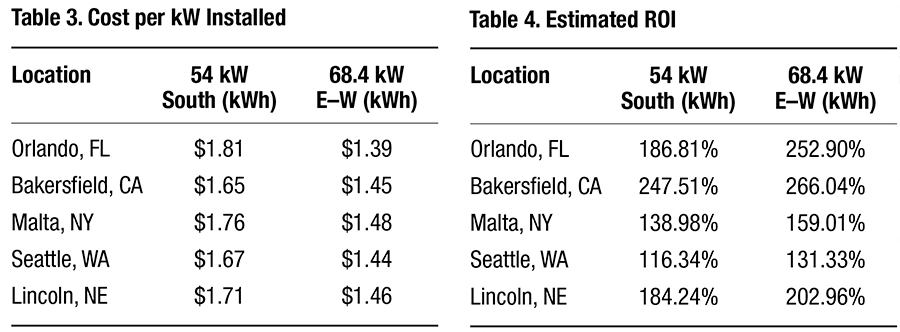
For example, with a $20k budget in Seattle, a south-facing layout would allow for up to 11.69 kWp of installed capacity, producing about 11,228 kWh in the first year.
With the same budget using an east–west configuration, you could install up to 13.69 kWp of PV, with an estimated annual production of 12,074 kWh.
Payback and ROI: Where the Comparison Becomes Real
Payback Period. Payback refers to how long it takes for the system’s savings (from electricity generated) to recover the initial investment.
The analysis for the city of Orlando assumes an electricity price of $0.11 per kWh and a 6% annual increase in electricity rates. The east–west system reaches payback sooner than the south-facing system, reflecting its higher production and lower cost per kilowatt.
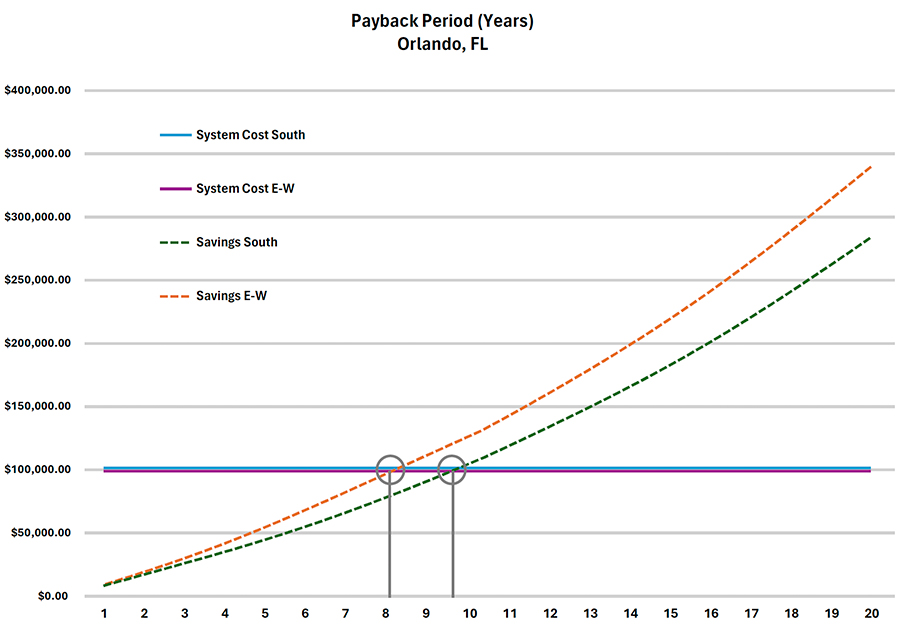
Payback time in years, Orlando, FL. © Baker Makarem
A shorter payback also leaves more financial margin over the system’s life to cover capital expenses, such as inverter replacements.
Return on Investment (ROI). This is another metric to consider, which measures net savings vs. investment. Across the 5 scenarios, the ROI ranged between 130% to 252%. These values can vary depending on expenses during the 20-year estimated lifespan of the system.
The message is consistent: in these examples, east–west layouts deliver stronger ROI because they install more capacity per roof area and typically do so at a lower cost per kilowatt, with higher energy production, compared to what can be installed facing south.
A Few Important Considerations
These exercises were intentionally simplified to focus on layout trade-offs. Several real-world factors can change outcomes:
- Savings were calculated without rebates or incentives. Which is, in some aspect, a better perspective, since the Federal Solar Investment Tax Credit (ITC) is no longer available.
- For commercial projects, depreciation treatment can shorten payback periods and increase ROI.
- Operations and maintenance costs were not modelled in detail. While these systems will incur maintenance expenses over a 20-year lifespan, the overall profitability remains strong.
- It is also worth noting that east–west arrays often produce a broader daily generation profile, with more output in the morning and late afternoon. In markets with time-of-use pricing and demand charges, this flatter production curve can add additional value.
Takeaways
East–west solar configurations are not a replacement for south-facing systems, but they can be more profitable in the right scenarios.
They tend to perform best when:
- The surface is flat (common in commercial buildings)
- The design uses low tilt angles (5° to 10°)
- Roof area is the primary concern
These conditions are common in commercial buildings, warehouses, and increasingly in floating PV systems. As floating solar continues to develop, east–west layouts may play an important role in maximizing energy output per available surface.
Sometimes, the best solar design is not about chasing the perfect angle, but about making the most of the space you have.
About the Authors
Baker Makarem is a Mechanical Engineer and NABCEP-certified ESIP, PVIP, and PVSI. He is the founder of Bakertech, a company specialized in the photovoltaic (PV) and energy storage systems (ESS) industry. He has been in the renewable energy field since 2017.
Carla Monzer previously worked as a marketing consultant in a global market research firm providing consumer, industry, and market intelligence. She is currently a PhD student in Marketing at the University of South Florida. Her research interests focus on sustainability, with particular attention to renewable energy and its interaction with consumer behavior.