




By Gale Marsland January 21, 2026
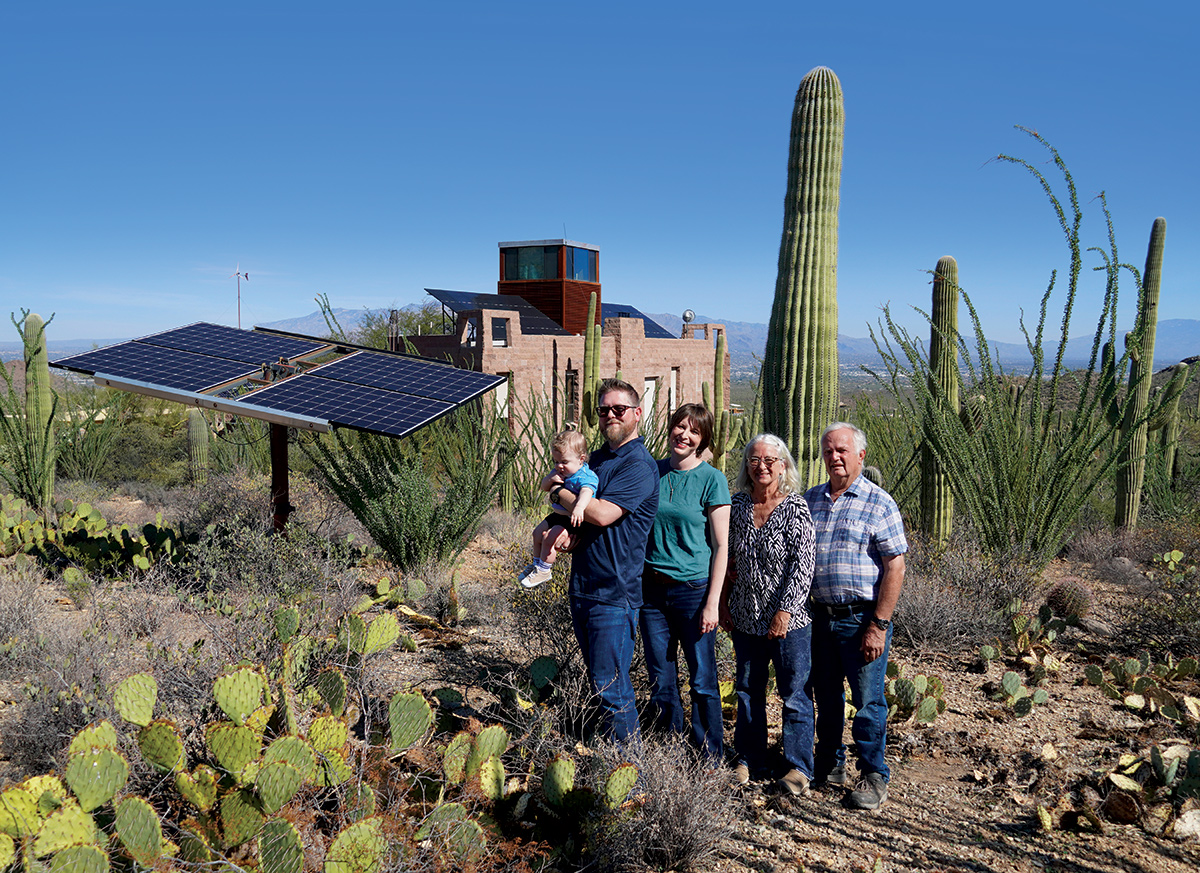
Gale and Richard Marsland (on right) with their son Matthew, his wife, Kathleen, and their son Avery. © Gale Marsland
We have been living off-grid for over 35 years and have been involved in designing and building sustainable homes and communities for much of that time. We are determined to pass on knowledge and lessons learned. It has been a major life goal to promote the use of solar energy and other sustainable practices. It is gratifying to see all the advances, but there truly were times when we wondered if solar was ever going to grow, as the resistance from the fossil fuel industry is/was so very powerful and influential.
In a Sahuaro Forest
We moved to this property, an old mining claim surrounded by Sahuaro National Park in Arizona, in 1988. The nearest neighbor and power were almost two miles away. We had been designing and building passive solar homes for some time, and this was our chance, finally, to live off the grid. It has been a wonderful experience, and we have learned many things, refined many concepts, and had great fun imagining ‘what ifs…’ Throughout those 35 years, we have witnessed knowledge, techniques, equipment, and systems steadily improve.
Our house was on the cover of Solar Today magazine, Sept/Oct 1996. We have come a long way since that time. It is beneficial to look at how things have changed and how to advance sustainable practices as time goes on.
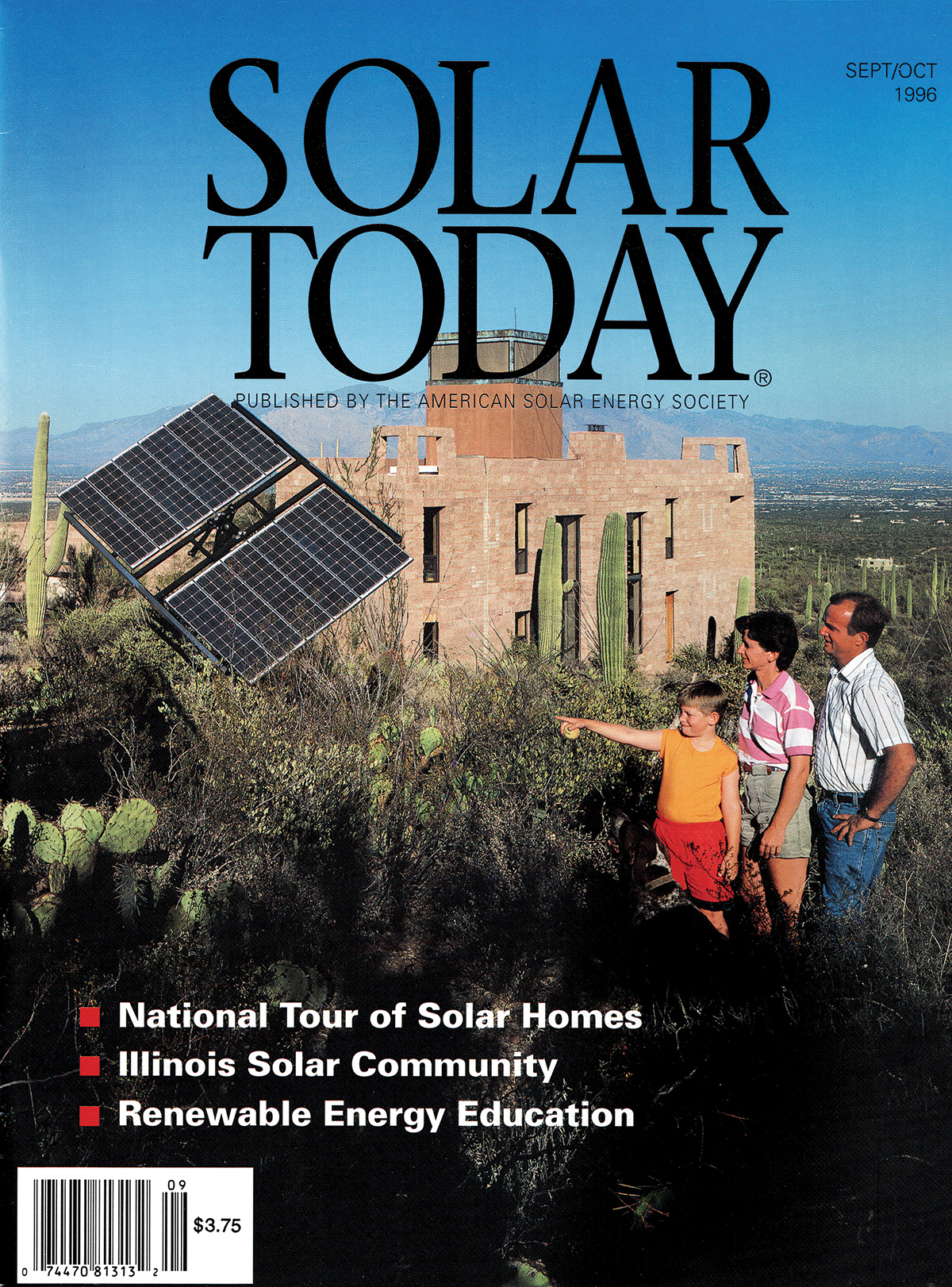
Gale, Richard, and Mathew Marsland featured on the 1996 Sept/Oct cover of Solar Today magazine.
Why Do Off-Grid
At the time we built our home, there were many reasons to take on the challenge of designing and building an off-grid home. We:
- Believed in climate change and wanted to contribute in every way possible.
- Considered ourselves to be innovators, problem solvers, and liked high-tech modern stuff.
- Wanted to access the incredibly abundant solar resource where we lived.
- Believed in having a small footprint and finding more ways to do that
- Wanted to be independent from monopolies and institutions.
- Knew that life cycle costs could be less, over 30 years x $166/month = $60K.
- Wanted fewer neighbors and to be surrounded by the natural environment.
- Still hold these values as paramount.
Electricity Supply was the Initial Main Driver
Due to high costs and limits of technology in 1988, of utmost importance to us was to focus on reducing electricity needs as much as possible. Although strategies vary in different climates, some aspects remain the same and have similar solutions. We chose to operate several systems with propane: backup hot water heating, hot tub, dryer, and
space heating.
Energy Efficient Components
Building efficiency into the design of the home, we used the best available insulation for walls and roof, and high-quality windows and doors. We originally used the curliecue fluorescent bulbs, but now we have replaced them with LED bulbs, which use only 10% of the original incandescent bulbs’ wattage. When buying appliances, we chose the most energy-efficient available. The Energy Star website was very helpful. Originally, we used a propane refrigerator, then a super-efficient DC refrigerator that became available later. Now we use the readily available high-energy efficiency refrigerator
and appliances.
Passive Solar for Heating
In this sunny climate, we are able to do 90% of our heating with passive solar. We have a wood fireplace and a small propane heater for cloudy days. We can also use the mini-splits for backup heating. Passive solar components have not changed much and work to a degree in many climates.
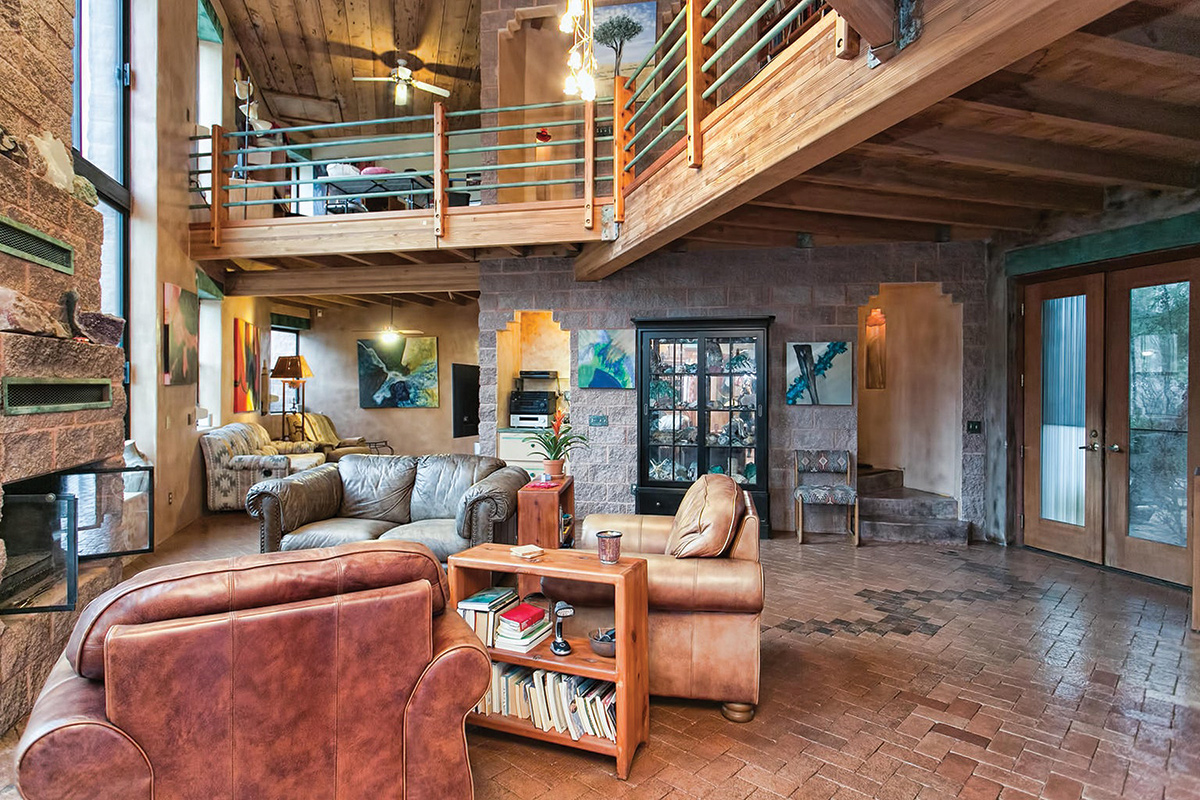
The living room is the thermal mass and has south-facing windows. © Gale Marsland
Our house has large, true south-facing windows. They allow the sun in the entire width of the house in the winter and barely come in even a foot in the summer due to the sun’s high angle in the sky. Exterior shutters allow us to control the amount of sun coming in, which is particularly helpful in the spring and fall. They also limit heat loss at night in cool weather, with an added bonus of privacy and security enhancement.
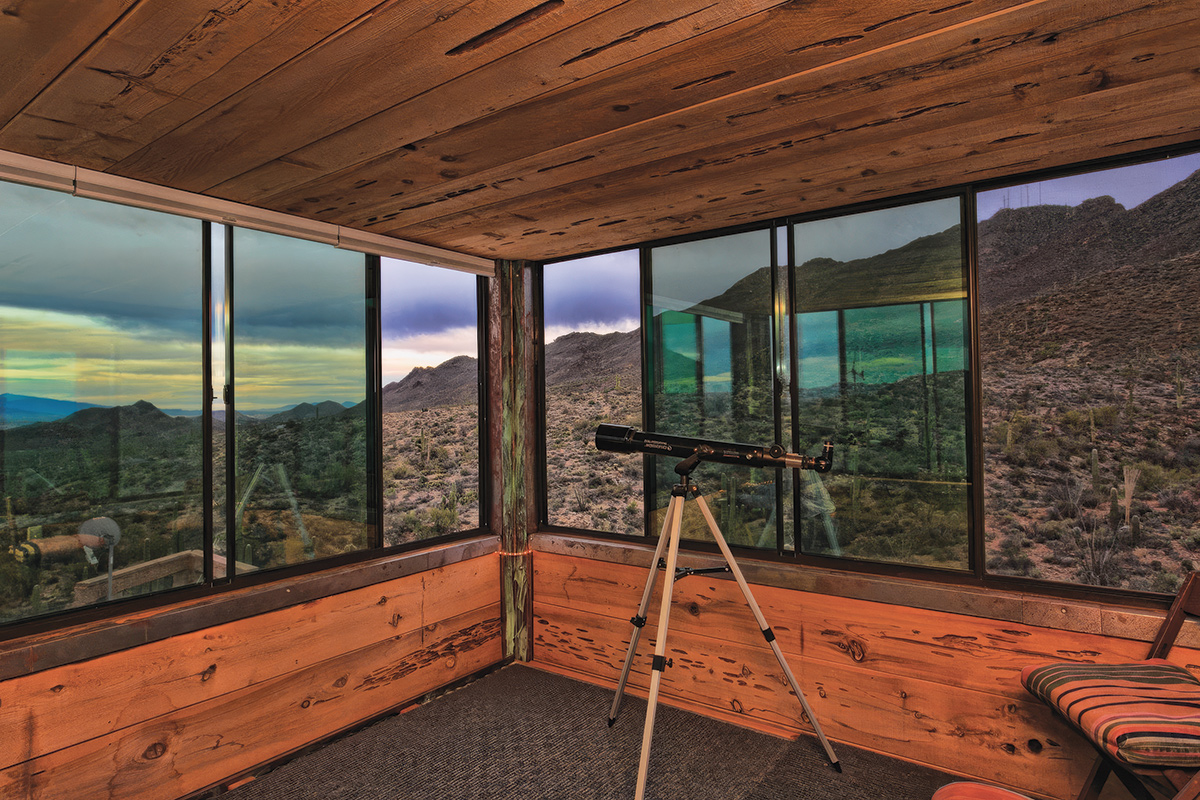
The Marslands’ repurposed the cool tower into a wonderful observation deck. © Gale Marsland
My husband comes from a family of masons, so it was natural to use high mass concepts. The exterior walls and most interior walls are block, and the floors on the first floor are brick. All of this mass stores coolth/warmth and keeps temperatures from fluctuating quickly. The exterior walls are 20” thick with a split-face block on the outside, which blends in with the natural environment. There are 2 inches of isocyanurate foam plus a 2 inch air gap in between, completed by a solid grouted concrete block wall on the interior. We got the mass, the insulation, and a no-care exterior. About a third of the walls are buried underground 3-4 feet, which further provides insulation and contact with even more mass.
Tackling the Biggest Energy User – Cooling
Summer cooling was our biggest challenge. Because of low humidity, we were able to use evaporative cooling and didn’t require air conditioning. Bill Cunningham at the Environmental Research Lab in Tucson helped us address cooling while maximizing solar energy use. Part of our solution was a cooling tower originally developed a thousand years ago in the Middle East, known as a malquaf.
Bill designed a 35’ tall, 10’x10’ tower, with thick evaporative cooler pads on all four sides at the top. Water dribbled from the top down into a gutter and then recirculated. It only used about 50 watts to pump the water! The water coming through the tower cooled the air and, being heavier, dropped passively into the house. Cupolas on the roof vented warmer air out. This resulted in incredibly low power needed for cooling a 2000 square foot area. However, it used a lot of water, about 3-400 gallons a day. With a dry well, we had to haul water. The cool tower also sometimes leaked and stained the ceiling.
Later, we switched to a high-efficiency solar chill evaporative cooler, also designed by Bill, using about 100 watts and only 100 gallons a day, which was a big improvement. Recently, we installed even more efficient AC mini-splits after adding to our solar array and generating plenty of electricity. The mini-splits use about 1000-1500 watts and ZERO water. Our comfort level is greatly improved, and we can just set a thermostat and walk away.
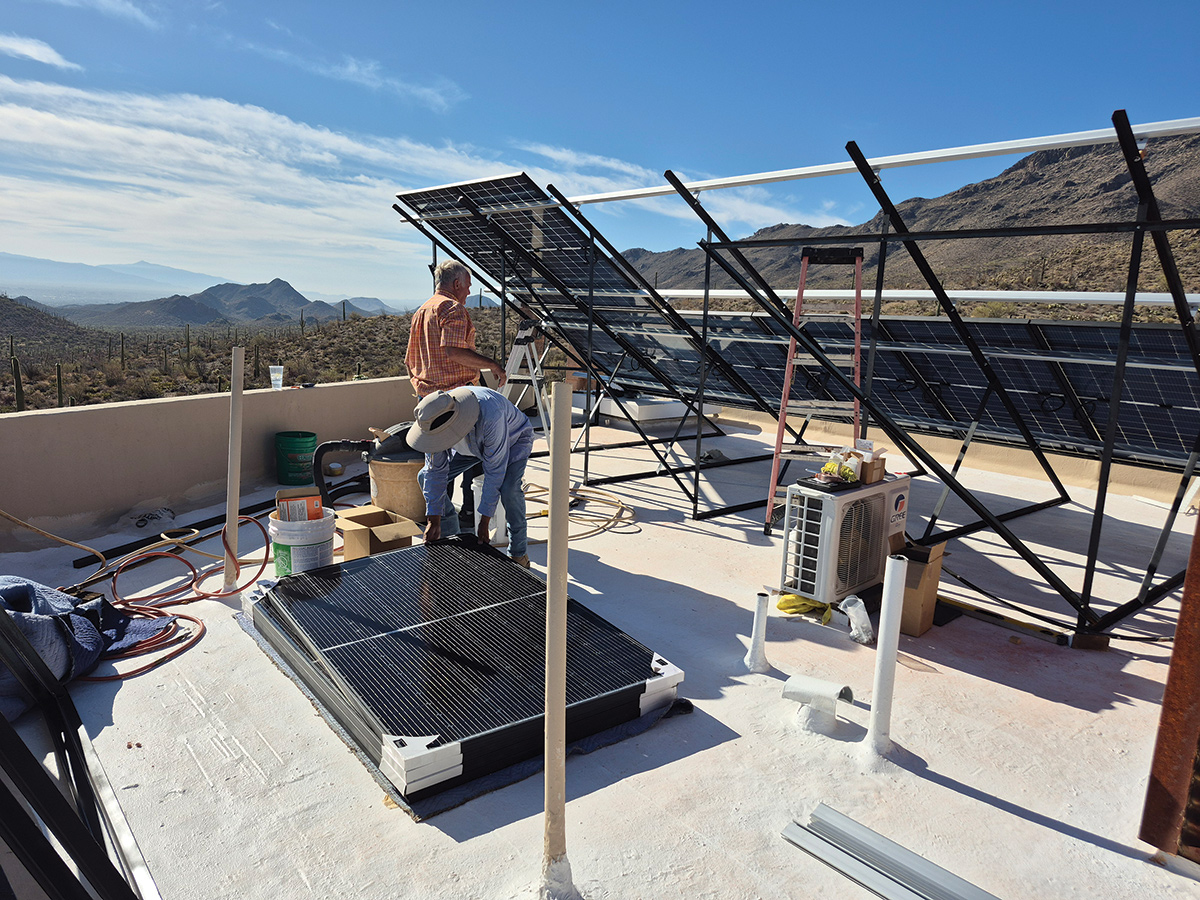
The 2024 PV being mounted directly on the roof. © Gale Marsland
Future Forward: More Photovoltaic (PV)
Components of Active Solar/PV have advanced significantly and are much more efficient. PV modules produce more energy per foot, and therefore take up less space. And prices are much cheaper now, too! Our first solar panels were $25/watt; the ones we most recently purchased were only $0.40/watt! Inverters are also now more efficient. Our original inverters were modified sine wave, and back then, even a few of our electrical devices didn’t work well with that. Modern sine wave inverters are essentially like grid power now. They also put out a lot more power than the older ones: 1,500 W on the modified sine wave versus 12, on my newest one. The controllers and interfaces are smaller, more efficient, and cost less, though not as much cheaper as the extreme reduction of PV modules. We originally used passive trackers to keep the PV 90 degrees into the sun as it moved through the day to maximize output. Now, due to increased efficiency and decreased cost, our newest panels are stationary on our roof.
Another important advance over time is that there are more local businesses installing and maintaining solar systems. Larger national companies are marketing DIY systems and also offer tech support, including Wi-Fi connections that enable technicians to access your system and advise on installation and maintenance issues. When we upgraded, we took advantage of investment tax credits that, unfortunately, are ending on December 31, 2025. Some rebates and incentives will remain in some states and municipalities to help reduce costs, but you have to be in the right state.
Current Challenges
Climate change and extreme weather events are making the grid more vulnerable. Redundancy, duplication, diverse sources, and focus on DISTRIBUTED generation are critical. Our house has two parallel PV systems, and each is backed up by a generator. We also have a transfer switch so that if one system has problems, the other can provide power for it.
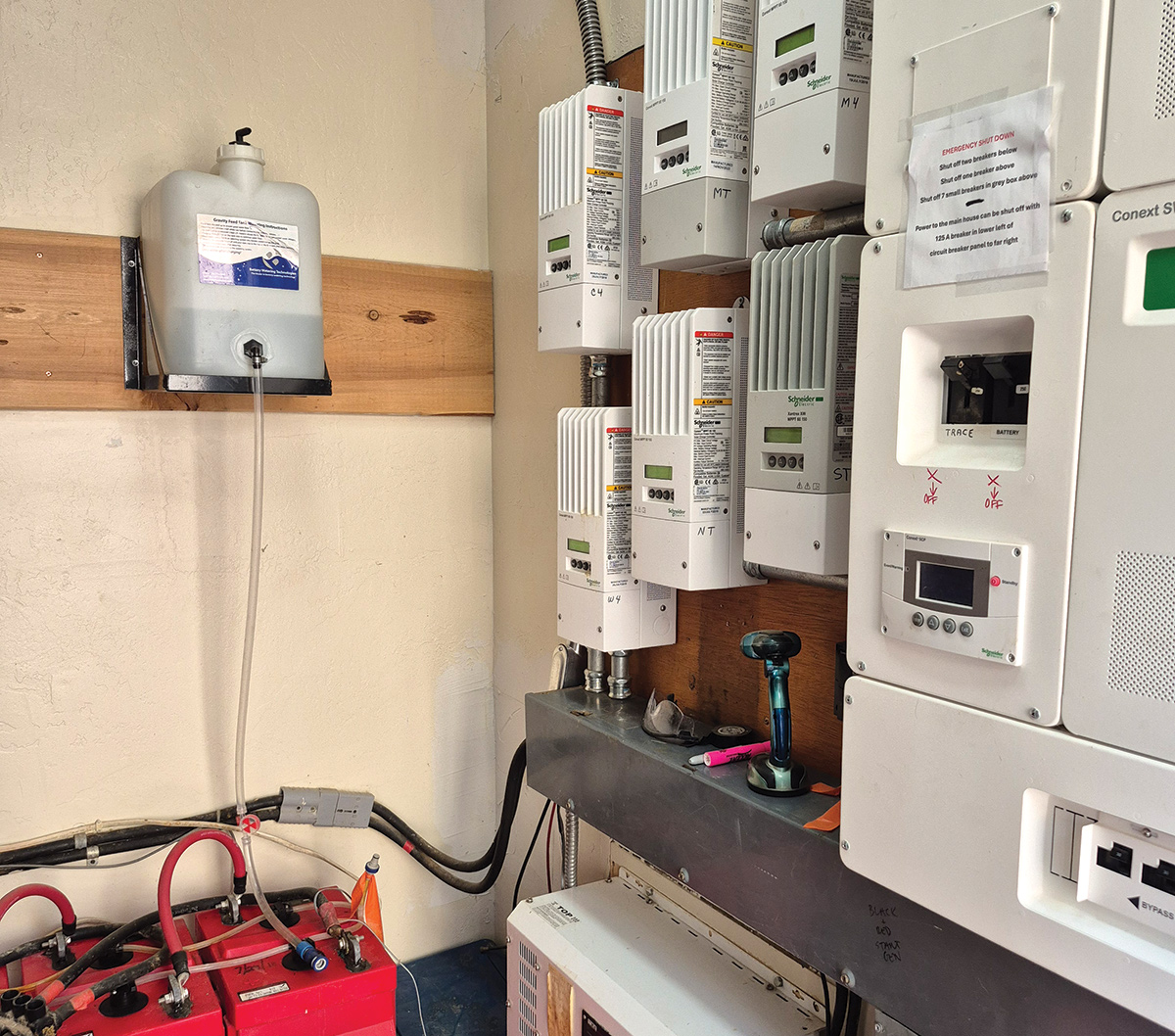
A 2017 upgrade included adding an automatic battery watering system. © Gale Marsland
Currently, the vast majority of homes with PV have no storage, back-up, or ability to use the power they are generating when the grid goes down! Most solar companies today are installing grid-tied systems with no batteries. Locally and anecdotally, there are very few companies that are interested in or even capable of installing battery backup systems. There is limited access to service, repair, maintain, or upgrade batteries. This is why so few people make this choice. The hope is that this market will grow and evolve so that it will be more like buying an appliance: bring it home, and plug it in. It is of vital importance to grow the infrastructure for installation, service, and maintenance for these full systems.
The solar community (researchers, tech developers, manufacturers, distributors, installers, community leaders, and organizations like ASES) needs to strengthen and build connections to take on some major portions of the grid in diversity and redundancy. We need to grow influence and power to compete with fossil fuel interests. A goal would be to promote distributed generation, where the individual has major benefits and solar growth is not just in the direction of corporations or utility companies.
Off-Grid Regret
We have only one regret about being off the grid. Seasonally, our power usage changes dramatically, as happens in many climates. Our latest system was designed around summer cooling needs. The other six months of the year, our needs are thirty percent less. So, IF my system fed back into the grid, we would be CONTRIBUTING. But the cost of bringing power up here- the last time I checked in 2018 – was over $60,000. It does not make sense to pay that plus a small monthly fee just to feed the grid. As I write this in October 2025 at 11 am, 17K of my 18K PV feed is already shut off, and batteries are at 100%. What a waste….so our best choice would be grid-tied with battery backup, and GET IT ALL: independence, clean energy, and contribution to the grid.
There are many sunny places, like Tucson, where you absolutely should invest in battery backup.
About the Author
In the 1980s, Gale Marsland designed passive solar homes and partnered with a PV installer in the mid-90s doing mostly off-grid. As time went on, she got more involved in the solar community and was a media spokesperson for ASES Buildings Division and on the Editorial Advisory Board for Solar Today magazine. In 2001, she drifted into planning, designing, and building sustainable communities.