



By Jay Warmke August 5, 2026

© Nano Banana
The short-term load demands that will be placed on the electrical grid over the next four years will be unprecedented. After several decades of near zero load demand growth, the system is about to see an energy shock akin to the oil crisis of the 1970s.
Unprecedented Load Demand Growth
In combination, the added load demands on the nation’s grid from the following sources may well see an over 40% growth by 2030.
- Data centers (+12% – S&P Global Research1)
- Crypto-currency mining (+3% – Carnegie Mellon University2)
- Electric vehicles (+9% – NREL3)
- Shifts towards the electrification of heating and industry (+8% – International Energy Agency4)
- Climate change (+10% – IEA5)
Assuming these projections are accurate, the US grid would have to add about 126 GW of new generating capacity each year for the next four years. Current trends would indicate that it will not even come close to meeting those numbers. The most ever added to the grid in a single year occurred in 2002 when nearly 60 GW of new generation came online. And permitting already in place for 2026 indicates that at best the grid will see the addition of 40 GW of solar, 20 GW of battery storage and 10 GW of new wind generation (70 GW total).6
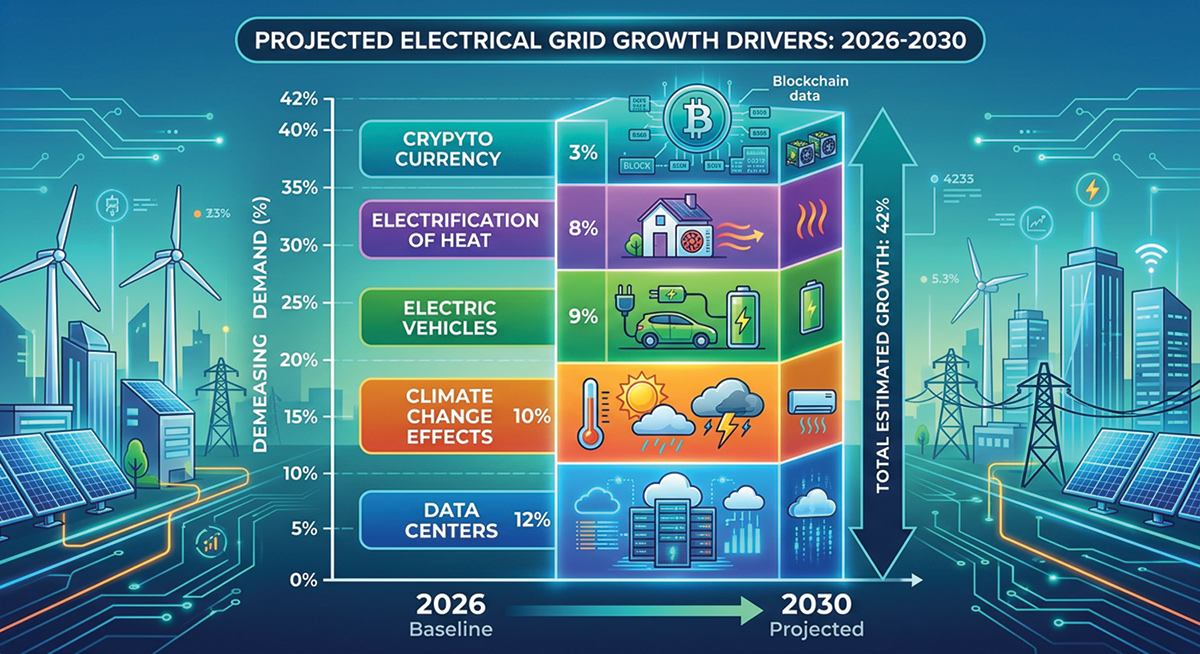
Projections from various studies indicate the US grid may experience over 40% in load demand over the next four years. © Firefly generated
In sum, new generation capacity can only meet a fraction of the anticipated load demand growth. So where will this new power come from?
It is clear that the adoption of AI is part of the problem (see chart above – data centers), but perhaps it can also be part of the solution. Integrating artificial intelligence into the management of energy consumption and distribution of homes, businesses, and even the grid itself may go a long way towards addressing these shortfalls.
The Grid has a lot of Headroom
While total load demand is important, from the grid’s perspective it is even more important when the demand occurs. The electric grid is designed to meet peak demand, the few hours in a year when the most electricity is used, not average load demand. In other words, build for the worst and hope for the best.
As a result, there is extra generating capacity built into the design – but only if it can be used effectively. AI may be just the tool required to assist in making that happen.
In 2026 the capacity utilization for U.S. electric power generation, transmission, and distribution sits at about 72%.7 This means that on average, the grid operates at about 72% of its maximum sustainable capacity. This is an historically low percentage (see chart to the right), meaning there is a tremendous amount of potential generating capacity that could be unlocked with the right management tools.
The grid currently has about 1,353 GW (1.35 terawatts) of generating capacity. Unlocking this capacity potential is the equivalent of building an additional 380 GW of new power generation.
Much of the additional capacity headroom is the result of the grid’s greater reliance on renewable energy such as wind and solar. Given the variability of these resources, a larger cushion has been required to ensure grid resilience. But the addition of batteries and the integration of demand response tools may allow operators to unlock that capacity while still maintaining a resilient grid.
Grid Demand Management
Utilities can employ a combination of technologies, software, and management strategies designed to better balance electrical supply with demand. These can be especially useful in reducing peak load demand. The most direct way of lowering peak energy demand is to deal directly with the sources of that demand. This may involve reducing loads through predictive heating/cooling systems that monitor weather forecasts and minimize heating and cooling when the space is unoccupied — but then pre-cool or pre-heat living spaces just prior to when people return. AI can also be instrumental in monitoring and controlling adaptive lighting and reducing the need for phantom loads.
The Department of Energy (DOE) estimates that 20-60% of all energy used in the average US home is wasted.8 Minimizing even a fraction of this waste can go a long way towards bridging the looming energy gap.
Additionally, the promise of the “smart grid” may actually become a reality with the help of AI. Controlling certain loads during times of peak load demand – such as turning off hot water heaters or EV charging stations – can significantly flatten the demand curve.
Real-Time Pricing
Economics are obviously a huge incentive. Time-of-day pricing schemes have been implemented across the country in an effort to entice consumers to use more power when it is readily available and cut their consumption during high demand periods. These pricing schemes reflect the reality that utilities often face quite different costs when providing power, depending on load demand.
Average wholesale electricity prices across the U.S. generally hover between $20-$40 per MWh. However, during extreme weather events those prices can soar to several thousand dollars per MWh. As a result, consumers often purchase power at prices that are well below cost during some hours and well above cost in others. Trying to match these events can be confusing, causing consumers to simply ignore complex rate structures. As a result, a study by Wharton estimates that traditional time-of-use pricing policies only deliver 17-20% of the efficiency gain that would be possible with real-time pricing.9
Real-time pricing (RTP) seeks to lower cost and reliability risks by passing through actual supply costs to consumers as they occur. Imagine a time when the price of electricity will vary second-to-second based on how much demand is on the grid at that moment. By encouraging load shifting (running loads that are not critical during a time of lower-cost power), RTP can help smooth and flatten demand curves.
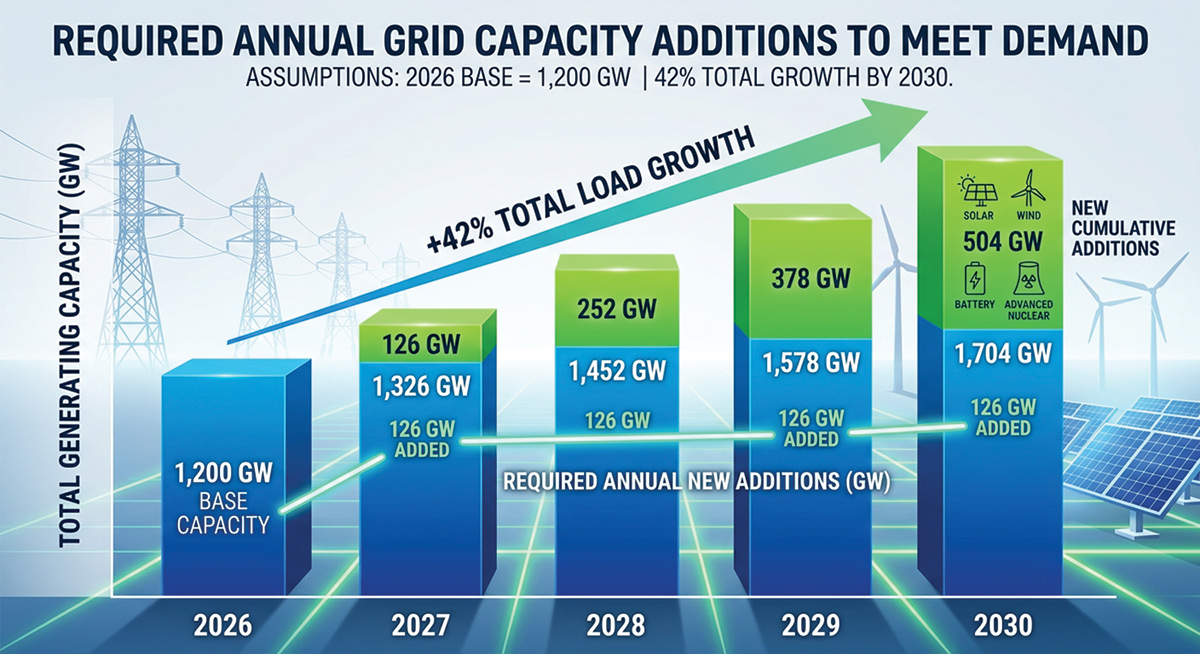
In order to meet anticipated load growth, the grid will need to unlock over 120 GW of new power sources each year through 2030. © Firefly generated
But clearly, in order to make this vision a reality, constant and real-time monitoring and controls must manage the system. And here is where AI comes into play. Utilities will require AI-enabled systems that track and price energy costs on a real-time basis. And consumers will need AI-enabled systems, controls and appliances to take advantage of the dynamic pricing. Everything moves simply too fast for humans to monitor and control these constantly shifting systems.
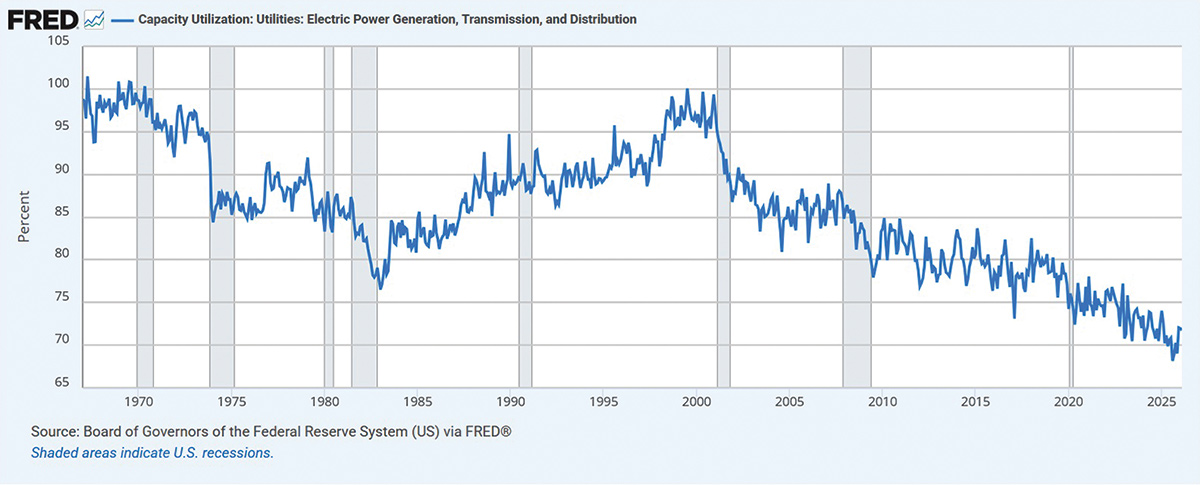
Utilization rates have steadily declined since 2000 as more and more renewable generation sources have been added to the grid. © FRED
Virtual Power Plants
The grid was designed as a network of utilities which controlled (within their service area) all electrical generation as well as all electrical loads (turning them off when supply could not meet demand). This is clearly no longer the case.
The proliferation of distributed energy resources (primarily solar and storage) is taking control out of the hands of the utility and placing it into those of the customers. All those distributed sources of energy represent yet another potential energy resource that could be better harvested to meet the needs of the grid.
SEIA (the Solar Energy Industries Association) tells us that “Virtual Power Plants (VPPs) are a network of small energy generation sites—think hundreds of homes with rooftop solar—that are combined with storage technologies like home batteries and electric vehicles to help grid operators manage peak demand, improve affordability, and bolster grid resilience.”10
And there is a lot of potential energy out there. The DOE estimates that by 2030 virtual power plants could provide 80-160 GW of capacity, meeting 20% of peak load demand. And this is energy that can be had at an affordable cost. The DOE further estimates that a new 400 MW virtual power plant would have a net cost of $43 per kW-year, while a similarly sized gas peaker plant would cost about $99 per kW-year.11 Once again AI will be required to effectively manage these resources, moving power from where it is available to where it is needed on a real-time basis.
Predictive Everything
With the integration of AI into all aspects of the grid, comes the ability to predict events and control response to all aspects of the grid.
Predictive hyperlocal weather data will enable grid operators to analyze temperature, humidity, and extreme weather events on a granular level, allowing utilities to anticipate load spikes during heatwaves or cold snaps, optimize renewable generation (solar/wind), and pre-position crews for potential outages.
Predictive equipment maintenance will soon allow utilities to forecast equipment failures before they cause power outages. Rather than dealing with failures as they happen, utilities can reduce unplanned downtime by 50–70% and lower maintenance costs by 20–40% according to studies by the DOE.12
AI has the potential to change nearly every aspect of our lives. The grid will be no exception.
The nation’s utility grid is a highly complex network of millions of interconnected devices. A perfect playground for AI. Grid operators are already envisioning a day when AI models will investigate and troubleshoot potential problems, automate workflows, and take autonomous actions based on AI-driven insights.
Is the grid now a relic of the past?
As the way power is used and delivered is altered dramatically over the next few years, it is not outside the realm of possibilities to assume that AI will also reshape the very utility model that has remained largely unchanged since the days of Edison and Tesla.
With the rise of virtual power plants, it may prove to be only a short leap in regulatory logic to find the first virtual utility competing with the traditional investor-owed incumbents. Virtual utilities that manage vast amounts of power transactions without owning a single power plant or a meter of wire.
And as homeowners and businesses find that they can install off-grid systems more cheaply than continuing to purchase power from the grid – utilities will have to change their business model from thinking of themselves as electricity providers to thinking of themselves as the facilitators of connected energy services. We have seen these transitions before as technology reshapes long entrenched systems: the destruction of “Ma Bell” in favor of wireless telephony and the explosion of the Internet; the emergence of virtual banks such as PayPal and Venmo.
As Douglas Adams once said, “Technology is the name we give to stuff that doesn’t work properly yet.” And AI certainly fits that bill at the moment. But once it gets its act together, it will help to transform how we use electricity in ways we cannot yet imagine.
About the Author
Jay Warmke is the author of numerous green technology books and has developed renewable energy curriculum for many colleges and universities across North America in his capacity is the owner of Solar PV Training LLC. He has served as vice president of the board of directors of Green Energy Ohio and as president of the International Certification and Accreditation Council. In 2015 he was elected to ETA’s Board of Directors and for the past 10 years has served as Chair of the Renewable Energy Committee. He also currently sits on the ASES editorial advisory committee.
- tinyurl.com/SPGlobaldata
- tinyurl.com/cryptoloaddemand
- tinyurl.com/EVloaddemand
- tinyurl.com/heatloadIEA
- tinyurl.com/climatechangeIEA
- tinyurl.com/2026newgen
- tinyurl.com/gridcapacityutilization
- tinyurl.com/DOEenergyefficiency
- tinyurl.com/TOUpricing
- tinyurl.com/SEIAVPP
- tinyurl.com/SEIAVPP
- tinyurl.com/DOEpredictmaintenance
AI could transform electricity use by making demand forecasting, grid management, energy storage, and renewable integration far more efficient. The real opportunity is using AI to build a smarter, more resilient, and cleaner energy system.