



By Angela Lipanovich, Esq. and Jenny Folkesson, PhD. August 5, 2026
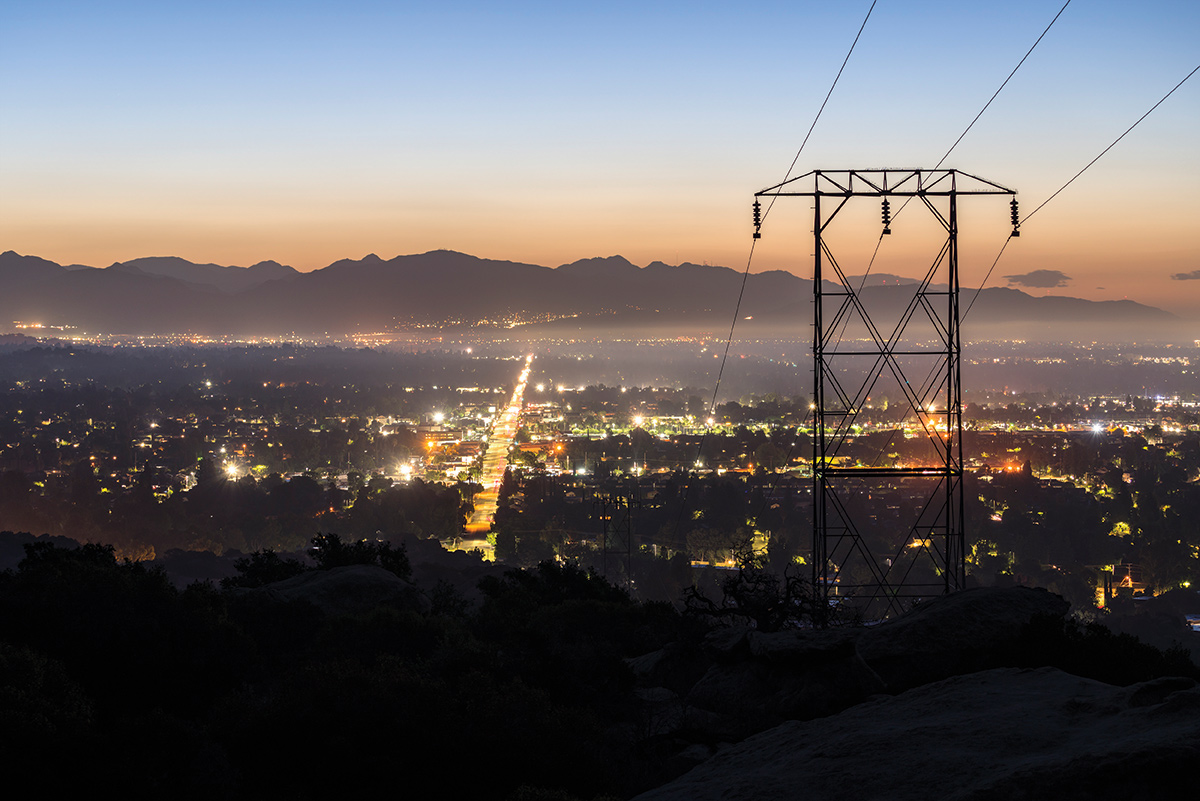
Powerlines above the city of Los Angeles, California. © trekandshoot
Californians are paying the second-highest residential electricity rates in the Country, and a popular explanation — that rooftop solar customers are shifting costs onto everyone else — has it backwards.1 Bundled average rates in PG&E’s service territory rose from roughly $0.24 per kWh in 2018 to $0.37 per kWh in 2024 in real USD — an increase of about 52% in six years after accounting for inflation.2 That trajectory is real, painful, and worth solving. But the data show that the principal drivers are wildfire-related capital spending, an aging long-distance transmission system, electric rate design flaws, and authorized utility returns3 — not the roughly 18 GW of customer-owned solar that Californians have installed since the early 2000s.4
This article explains how data and the law converge on two findings that lead to a single conclusion. First, the largest, fastest-growing components of Californians’ electric bills are utility capital costs — wildfire hardening, transmission expansion, and grid infrastructure — driven by forces unrelated to rooftop solar, and which distributed solar measurably helps to constrain by reducing peak transmission load and deferring infrastructure investment. Second, California’s rate-making framework — built for a one-way grid that no longer exists — neither credits the system benefits that customer owned solar delivers nor allocates costs and benefits fairly across ratepayer classes. Modernizing rate design, by unbundling the recovery of fixed grid infrastructure costs from the variable price of energy generation, is the structural fix. Together, these findings point to one conclusion: the most realistic path to affordability as electrification, EV charging, and data-center loads expand is to revisit our approach to rate design and to help many more Californians — especially renters, small businesses, and dense urban neighborhoods — own their own solar-energy supplies.
What is Actually Driving the Rate Increases
PG&E, California’s largest investor-owned utility (IOU), charged residential customers an average of $0.39 per kWh in June 2025.5 When economists, such as those at U.C. Berkeley’s Energy Institute at Haas, dissect the typical California residential rate, only about 12–15 cents per kWh reflects the competitive marginal cost of generating and delivering electricity.6 The remaining 25 cents or more covers fixed cost-recovery for capital projects, public-purpose programs, securitized wildfire claims, and authorized return on the utility’s investments.7 The California Public Advocates Office attributes roughly 21% of the rate — about $0.08 per kWh — to wildfire-related capital and operating costs, making them the single largest driver of recent rate increases.8
PG&E’s 2020 and 2023 General Rate Case decisions, together with separately recovered wildfire-cost memorandum accounts, authorize billions of dollars annually for vegetation management, system hardening, public safety power shutoffs, and undergrounding.9 PG&E’s 10,000-Mile Undergrounding Program alone has been projected at costs ranging from approximately $3 million per mile to nearly $6 million per mile, depending on terrain, urbanization, and contractor pricing.10
California’s liability framework intensifies that pressure. Under inverse condemnation as applied to IOUs, an electric utility can be held strictly liable for wildfire damage tied to its equipment even where no negligence is found.11 Utilities have rationally responded by deploying as much capital as the CPUC will authorize.
Authorized capital earns a regulated return on equity, which as of the date of this report, is between 10.23% and 10.33% for the three California IOUs, and above the national average.12 That return is paid on a rate base that has grown by more than 50% since 2018, but that far outpaces load growth, which has been essentially flat over the same period. Out of this dynamic has emerged the cost-shift claim: that net energy metering (NEM), California’s program of bill credits for energy solar customers’ exports to the grid, amounts to a subsidy running from lower-income, non-solar households to wealthier solar owners. It is the most repeated argument against solar ownership rights in the state. However, the myth fails under scrutiny.
A Closer Look at the Solar Cost-Shift Myth
The “cost shift argument” compares the retail credit that NEM customers receive for exported energy with a modeled “avoided cost” the utility would otherwise pay.13 The “cost shift” that comparison purports to measure is largely a mirage produced by California’s rate design itself — a design that picks and chooses how to load ratepayers with costs they should not bear and fails to recognize the benefits that distributed solar provides.
The standard avoided-cost calculation is structurally biased against solar in three ways analysts have repeatedly documented:
(a) The Avoided-Cost Calculator (ACC) that drives the California Public Utility Commission’s (CPUC’s) NEM cost-effectiveness analysis excludes documented benefits of distributed generation — avoided line losses, deferred transmission and distribution upgrades, locational capacity value during net-peak hours, and resilience benefits during Public Safety Power Shutoff (PSPS) events.14
(b) Rooftop solar reduces the same wildfire-related transmission build-out that drives most of the rate increase discussed above.15
(c) The calculation is sensitive to which year’s gas price, capacity-value methodology, and discount rate the analyst chooses.16
A deeper problem is that the purported “cost shift” occurring does not measure a transfer at all. The Natural Resources Defense Council’s (NRDC’s) Powering Change report shows that the dynamic behind California’s rising electric rates is not solar customers receiving a benefit at someone else’s expense. It is the mechanics of how utilities recover their costs. NRDC’s analysis claims that today’s non-solar residential rates are approximately $0.07 per kWh higher than they would be without NEM, which is around 16% of California’s total residential IOU retail rate today; further, they state that $0.05 per kWh of that increase has occurred since 2018.17
Critically, NRDC characterizes that figure not as a payment from non-solar to solar customers, but as a rate-design construct: the consequence of behind-the-meter solar reducing IOU energy sales. It reflects the recovery of growing fixed costs on flat or decreasing demand by increasing rates, not a direct payment from one ratepayer to another.
That distinction matters. A “subsidy,” in ordinary usage, is “a benefit given by the government, or a public or private organization, to a person, business, or industry” requiring a direct, intentional transfer. What occurs with solar is a free-market outcome: utilities lose anticipated revenue when their customers generate some of their own electricity and sell the energy on the open grid. The compensation those customers receive for that solar energy is no more a “subsidy” extracted from the utility than the income a homeowner earns selling vegetables from a backyard garden at a farmers’ market is a “subsidy” extracted from the supermarket whose produce sales they displace. In both cases, the producer is paid for a good they grew or generated.
The comparison is also rigged by mismatched timeframes. The cost-shift figure is cumulative — the alleged share of the current residential bill accumulated across every NEM customer who has interconnected since 1997. The wildfire figure typically paired against it is a recent slice. Setting one against the other is like comparing the odometer reading of your car to the trip meter from this morning’s drive. Both are in miles. Neither tells you what the other does.
Compared on a consistent basis — recent against recent, or all-time against all-time — wildfire dominates by a wide margin.18 And the trajectories diverge from there. NEM 3.0, in effect since April 2023, sharply reduced export compensation for new entrants, structurally constraining NEM’s contribution to future rate growth. Wildfire spending has no such constraints.
Wildfire-related costs are the single largest driver of California’s residential rate increases. By any reasonable accounting, wildfire-related recovery is materially larger than NEM’s share of the residential bill, and the gap is widening as undergrounding capital, insurance premiums, and Wildfire Fund obligations continue to rise.19 The CPUC’s 2023 SB 695 report confirms that wildfire-related costs — mitigation, insurance, and liability — are the primary statewide driver of rate increases over the past decade. Solar customers, by reducing peak transmission load, are helping to mitigate the very wildfire-hardening build-out that drives those costs upward.20
Finally, the cost-shift framing has a deeper problem than its arithmetic: it presumes there is a net cost to apportion in the first place. Once the offsetting benefits of distributed solar are credited, that premise collapses. A 2024 analysis found that existing solar customers collectively reduced costs for all California ratepayers by approximately $1.5 billion in a single year — through reduced peak grid demand, deferred transmission investment, and lower wholesale energy procurement.21 And looking towards the future, grid-optimization modeling predicts that a distributed clean-energy system will be $88 billion less expensive to build and operate than a centralized alternative because Distributed Energy Resources (DERs) reduce the infrastructure that the long-distance transmission system exists to carry.22 The phrase “cost shift” has a much longer history in U.S. electric ratemaking than the present rooftop-solar debate. As Sharon Beder summarizes in Power Play, publicly owned utilities historically charged residential and commercial customers similar rates to industrial customers, while IOUs charged residential and commercial customers materially more to keep industrial rates competitive with the public-power neighbor next door.23 In 1994, IOU residential customers paid 31% more per kWh than publicly-owned residential customers, while IOU industrial rates were the same as public-power industrial rates. The structural pattern: IOUs have been shifting ratepayer costs among other ratepayer classes long before rooftop solar. Two further pieces of that historical pattern are visible in present-day California. First, ownership of the IOUs is concentrated among institutional investors, layered in multiple tiers of holding companies, and held by out-of-state hedge-fund stakeholders whose authorized return on equity is ultimately recovered from California ratepayers. Executive compensation at California’s largest investor-owned utilities (IOUs) is itself a cost of service that ratepayers ultimately pay. Most of it, base salary and cash incentives, is recovered as an operating expense in the utility’s revenue requirement, not through the authorized return on equity. Regulatory filings for fiscal year 2024 (reported in 2025) place IOU CEO pay among the highest in the nation. Sempra, the parent of SDG&E and SoCalGas, paid CEO Jeffrey Martin $21.5 million, ranking him the third highest-paid utility executive in the country.24 PG&E paid CEO Patricia Poppe $15.8 million with $1.4 million in base salary plus $11.7 million in stock awards and other compensation. Edison International, parent of Southern California Edison, paid CEO Pedro Pizarro $13.8 million.25 The trend has continued: an April 2026 report shows utility CEO pay rose 16% in 2025, with Poppe at $19.8 million and Pizarro at $16.5 million.26 Second, every dollar of rate base financed at a return is a dollar of revenue requirement that non-solar and solar customers alike pay to capital. In that real and quantifiable sense, all retail customers — including non-solar customers — are continuously “subsidizing” investor returns by billions of dollars per year. California’s 1996–2001 restructuring experiment is often cited as proof that “deregulation” failed. But that experiment did not let households or small businesses own their own electricity supply. It merely substituted competition among large generators for competition among utilities, while leaving the customer in the same passive role.27 Genuine competition for the customer means letting the customer own the means of production when doing so is technically and economically feasible. Regulating concentrated, capital-intensive generation and transmission assets is appropriate; restricting an individual household, school, farm, or warehouse from producing and storing its own clean electricity is not. The cost basis behind this conclusion is structural. Self-generated solar electricity is priced to the customer at the equipment cost and financed at consumer-loan rates, without an authorized return on capital, holding-company overhead, or executive compensation recovery. Each kilowatt-hour purchased from an IOU, by contrast, includes the utility’s authorized return on rate base, corporate overhead, and the share of fixed-cost recovery identified in the preceding section. The savings are not theoretical. The mechanisms to provide these savings are not novel — they are already in operation, at varying scales, in California and in other jurisdictions: fast track permitting, community solar programs, virtual net metering for multifamily housing, public-sector rooftop programs serving schools and warehouses, and successor tariffs that preserve cost-effective payback periods for solar installations. California’s electricity rate increase problem is real, and so is the search for someone to hold accountable. But the data point unambiguously toward failed utility rate structuring and IOU capital spending — driven by wildfire liability, authorized returns, and a long-distance transmission system that customer-sited generation actually relieves — as the dominant causes. California’s solar customers are not the source of the affordability crisis; the distributed solar industry is the most rapidly deployable, customer-aligned piece of the affordability solution. Stronger policies and regulations are needed to untap the ability to expand solar ownership opportunities, especially for renters, multifamily households, small businesses, and historically excluded communities. A structural solution is rate-design reform. If California unbundled the fixed costs of grid infrastructure from the variable cost of energy generation — rather than recovering both through a single volumetric per-kWh charge — infrastructure costs allocated to ratepayers would decline over time, because distributed resources reduce the very build-out those costs recover, and energy generation would be priced on free-market terms in which distributed generation competes on level footing with utility-scale supply. As long as rates remain bundled and grid infrastructure remains privately held by IOUs whose authorized returns depend on volumetric sales, the conflict between utility shareholder interests and solar system owners will continue to shape every rate-making proceeding. It is time to double down on policies that expand solar ownership rights not only as the best course for the environment, but also as the best course for the economic interests of all ratepayers. About the Authors Jenny Folkesson, Ph.D., is Executive Director and co-founder of SolarWAVE Action. A computer scientist trained at the University of Copenhagen, she brings two decades of experience in data science and machine learning, including image analysis at the Chan Zuckerberg Biohub. Her work centers on clean energy data analysis and the use of open-source code and data to support climate solutions and coastal and marine conservation.
The Historical – and Continuing – Cost Shift
True Competition Means Customer Ownership
Scaling those mechanisms is itself the most direct equity response, extending solar’s economic and resilience benefits to renters, multifamily residents, schools, small businesses, and dense urban neighborhoods that have historically been locked out of solar ownership. Conclusion
Angela Lipanovich is a clean energy attorney with more than twenty years of experience advising clean energy companies and the customers they serve. She founded Estriatus Law, co-founded SolarWAVE Action, and previously served as General Counsel to a publicly traded solar company. She has helped shape key policy decisions protecting solar ownership rights and is a long-standing member and former Board member of the American Solar Energy Society (ASES).
Thanks for your article.
Would it be possible to write about the new ‘balcony solar’ that is becoming very popular in Europe? It may be a way in which apartment renters can join in the solar revolution.
Thank You